Is Retail Roaming Revenue Set to Decline Further?

In the report, retail roaming refers to mobile roaming services provided to smartphone users, excluding Machine-to-Machine (M2M) and Internet of Things (IoT) connections. Retail roaming revenue is the income mobile network operators (MNOs) and mobile virtual network operators (MVNOs) generate from these roaming services.
The global retail roaming market is in flux. Connectivity is more important than ever to international travellers, but the businesses of MNOs are increasingly under pressure.
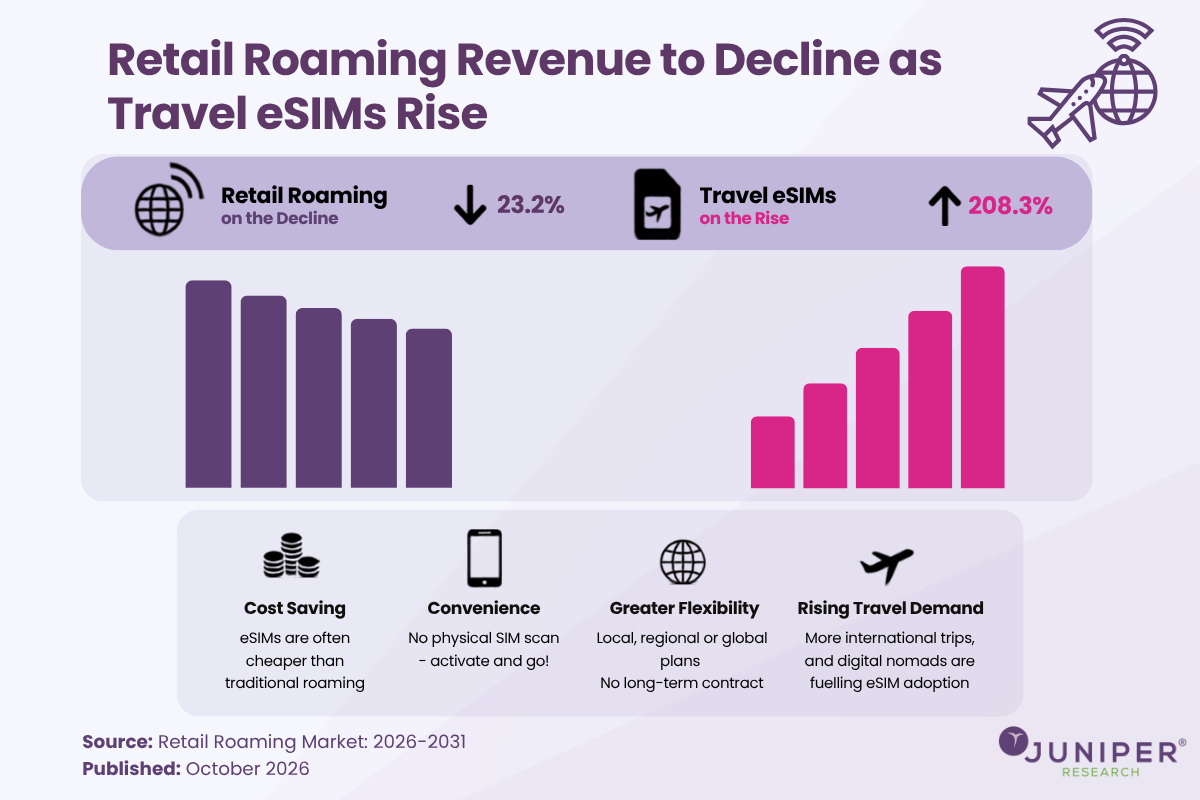
Juniper Research projects that the global retail roaming market will experience a consistent decline over the next five years; with revenue forecast to fall from $15.6 billion in 2026 to $11.4 billion in 2031. This 27% decline in retail roaming revenue is entirely due to the growth in travel eSIMs, which provide international travellers with an alternative to traditional retail roaming services.
Juniper Research expects that travel eSIM growth will drive an increase in silent roamers; with the number of silent roamers projected to rise from 602 million in 2026 to more than 1 billion in 2031.
About the Infographic
The graph highlights a significant shift in the travel connectivity market, with retail roaming revenue declining 23.2% from 2026 to 2030, while travel eSIM revenue is projected to rise by 208.3% during the same period.
This contrast indicates a growing preference among travellers for more flexible and digitally enabled connectivity options. The trend signals a potential change in how consumers access mobile services when travelling internationally, with traditional roaming increasingly facing competition from alternative solutions.
Several factors are contributing to the growing adoption of travel eSIMs. Cost savings are a key consideration, as eSIMs can often provide more affordable connectivity than traditional roaming services. They also offer greater convenience; removing the need for a physical SIM card and allowing users to activate a service digitally.
In addition, eSIMs provide greater flexibility, with local, regional and global plans available without requiring customers to commit to long-term contracts.
The growth of international travel and the increasing number of digital nomads are also supporting demand for travel eSIMs.
As more consumers require reliable connectivity across multiple destinations, the ability to switch between plans and networks digitally becomes increasingly valuable.
For businesses operating in the telecoms and travel sectors, this shift represents both a challenge to traditional roaming revenue and an opportunity to develop new eSIM-based services that align with changing customer expectations.
Source: Retail Roaming Market: 2026-2031
Read the Press Release: Retail Roaming Revenue to Fall $4 Billion By 2031, as Regulatory Restrictions and Competition Bite
Download the Whitepaper: Reimagining the Future of Retail Roaming – How Mobile Network Operators Must Adapt

Latest research, whitepapers & press releases
-
 ReportOctober 2026Fintech & Payments
 Michael GreenwoodAccounts Payable Automation Market: 2026-2031
Our Accounts Payable (AP) Automation research suite provides an insightful analysis of this rapidly growing market; enabling stakeholders to understand future growth, key trends and the competitive environment.
VIEW -
 ReportOctober 2026Fintech & Payments
 Jawad JahanCrypto-gaming Market: 2026-2035
Our Crypto-gaming Market research suite provides an insightful analysis of this rapidly growing market; enabling stakeholders - from crypto-gaming and sportsbooks operators, prediction market platforms, business-to-business (B2B) gambling platforms and software providers, to crypto payment processors and regulators - to understand future growth, key trends, and the competitive environment.
VIEW -
 ReportOctober 2026Telecoms & Connectivity
 Alex WebbRetail Roaming Market: 2026-2031
Our Retail Roaming research suite for mobile network operators (MNOs) and mobile virtual network operators (MVNOs) provides detailed analysis and strategic recommendations for the next era of retail roaming.
VIEW -
 ReportSeptember 2026Fintech & Payments
 Dr Manju ChhillarEmbedded Finance Market: 2026-2031
Embedded finance is one of the fastest-growing markets in financial services, and is about to accelerate even further. Our Embedded Finance Market research provides detailed analysis of the key drivers behind this growth, and what these mean for stakeholders in this market.
VIEW -
 ReportSeptember 2026Identity & Security
 Thomas WilsonApplication Security Market: 2026-2031
Our Application Security research suite provides detailed analysis of this emerging market; allowing application security providers to gain an understanding of key security trends and challenges, potential growth opportunities, and the competitive environment.
VIEW -
 ReportSeptember 2026Fintech & Payments
 Shane O'SullivanBanking Fraud Prevention Market: 2026-2031
Our Banking Fraud Prevention research suite provides a comprehensive and in-depth analysis of the types of fraud currently impacting the banking sector, and the evolving methods that can be used to overcome them.
VIEW


-
 WhitepaperOctober 2026Fintech & Payments
Jawad Jahan
WhitepaperOctober 2026Fintech & Payments
Jawad JahanCompliance or Anonymity - The Crypto-gaming Operator’s Dilemma
Our complimentary whitepaper, Compliance or Anonymity - The Crypto-gaming Operator’s Dilemma, analyses the current regulatory landscape of the crypto-gaming market.
VIEW -
 WhitepaperOctober 2026Telecoms & Connectivity
Alex Webb
WhitepaperOctober 2026Telecoms & Connectivity
Alex WebbReimagining the Future of Retail Roaming – How Mobile Network Operators Must Adapt
Our complimentary whitepaper, Reimagining the Future of Retail Roaming – How Mobile Network Operators Must Adapt, explores the emerging opportunities for MNOs within retail roaming.
VIEW -
 WhitepaperSeptember 2026Fintech & Payments
Dr Manju Chhillar
WhitepaperSeptember 2026Fintech & Payments
Dr Manju ChhillarEmerging Markets: The Next Opportunity for Embedded Finance
This free whitepaper examines how a combination of multiple factors is driving North America towards saturation for embedded finance.
VIEW -
 WhitepaperSeptember 2026Emerging Technology
Thomas Wilson
WhitepaperSeptember 2026Emerging Technology
Thomas WilsonVibe Coding: The Fastest-growing Threat to Application Security Today
Our complimentary whitepaper, Vibe Coding: The Fastest-growing Threat to Application Security Today, examines the state of the application security market; considering its impact on different verticals, and how it is being employed in these verticals to best combat malicious attackers and keep sensitive data safe.
VIEW -
 WhitepaperSeptember 2026Fintech & Payments
Shane O'Sullivan
WhitepaperSeptember 2026Fintech & Payments
Shane O'SullivanThe Fraud Frontier: Securing Banking in an AI-driven Era
Our complimentary whitepaper, The Fraud Frontier: Securing Banking in an AI-driven Era, examines the rapidly evolving state of the banking fraud prevention market.
VIEW -
 WhitepaperSeptember 2026Telecoms & Connectivity
 Nick Maynard
How Private Cellular Networks Are Unlocking Industry 4.0
Our complimentary whitepaper, How Private Cellular Networks Are Unlocking Industry 4.0, examines how private LTE & 5G networks are reshaping the way industry works.
VIEW


-
Fintech & Payments
The 25th NextGen Payments & RegTech Forum Arrives in Athens, Greece
October 2026 -
Fintech & Payments
Crypto Gaming: Wagers to Reach $1.3 Trillion by 2035, as Crypto Rails Widen Global Access Despite Regulatory Challenges
October 2026 -
Fintech & Payments
Juniper Research Unveils Identity & Security Award Winners for 2026
October 2026 -
Retail Roaming Revenue to Fall $4 Billion By 2031, as Regulatory Restrictions and Competition Bite
October 2026 -
Fintech & Payments
Soft POS to Surpass 100 Million Installations in 2030
September 2026 -
Fintech & Payments
The NextGen Payments & RegTech Forum Arrives in Dubai
September 2026