How Will Total Spend on Digital Identity Verification Checks Evolve Over the Next Five Years?

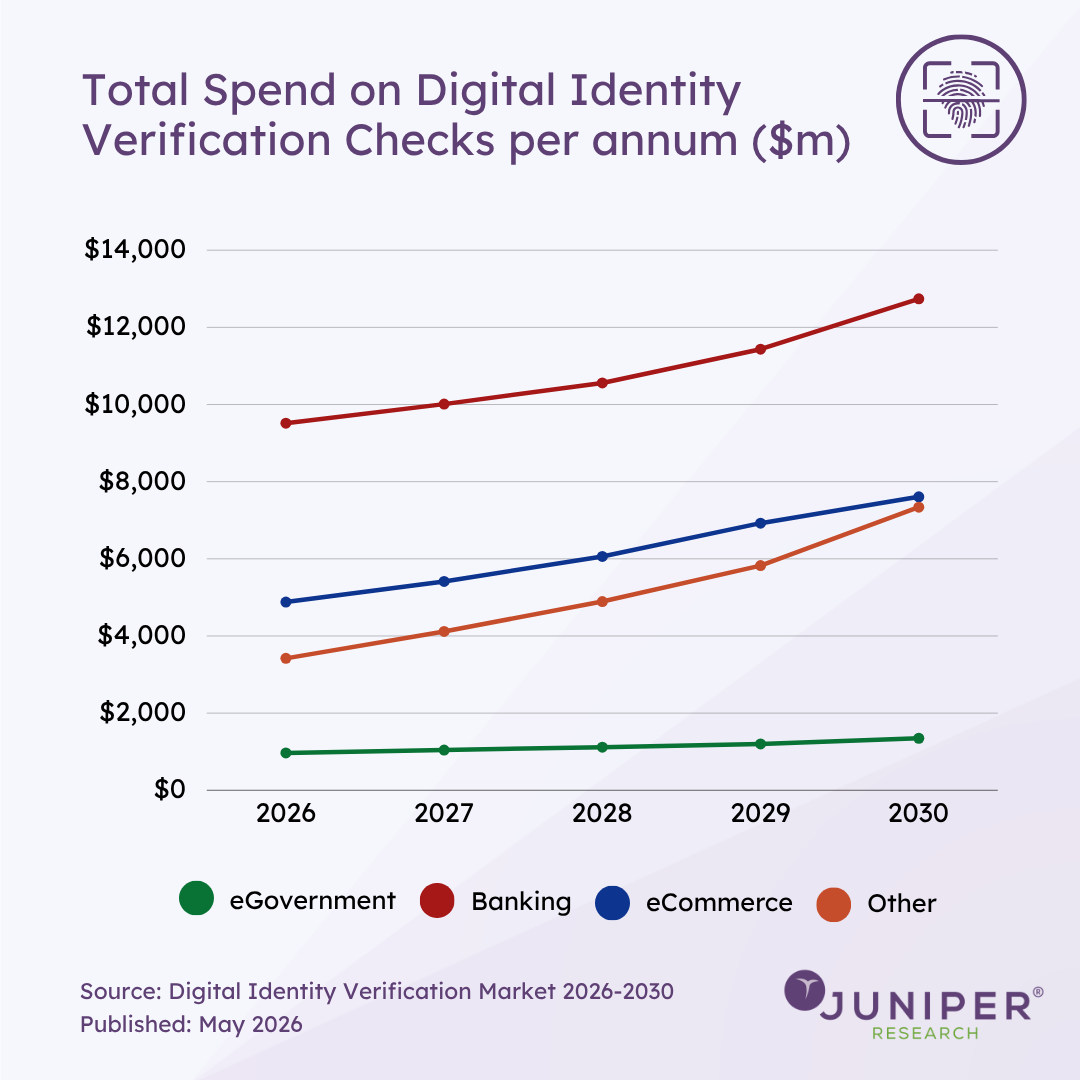
Juniper Research forecasts that the global total number of digital identity verification checks will exceed 175 billion by 2030; up from 100.4 billion in 2026. Meanwhile, the total value of digital identity verification checks is forecast to reach $29.0 billion in 2030; rising from $18.8 billion in 2026.
Verification is evolving from a one-time onboarding process into a continuous, lifecycle-based capability. Increasingly, businesses are recognising that identity risk does not end after initial verification. This is especially true in sectors such as financial services, eCommerce, and digital banking, where ongoing verification is becoming essential to fraud prevention and risk management.
About the Infographic
The graph highlights projected digital identity verification spend across key market segments over the next five years.
eGovernment Verification
Governments are among the world’s largest operators of digital identity infrastructure. Citizens demand faster, more accessible public services, from accessing benefits and healthcare, to filing taxes, renewing licences, and crossing borders. Identity verification sits at the heart of it all and has become central to everyday interactions.
The total number of eGovernment identity verification checks is forecast to grow from 2.0 billion in 2026 to 3.1 billion in 2030. Spending on digital identity verification checks for eGovernment services is expected to reach $1.3 billion in 2030; up from $966.8 million in 2026.
Banking Verification
The financial services sector is one of the most heavily regulated and technically sophisticated segments within the digital identity verification market. Banks, investment firms, insurers, payment providers, and fintech platforms all operate under extensive Know Your Customer (KYC) and Anti-money Laundering (AML) obligations, and identity verification sits at the core of their customer onboarding and ongoing monitoring frameworks.
Digital identity verification spending in the banking and financial services sector encompasses both onboarding and continuous verification.
The total number of digital identity verification checks in this sector is forecast to increase from 45.2 billion in 2026 to 64.5 billion in 2030. Meanwhile, global spending on digital identity verification checks in banking is expected to rise from $9.5 billion in 2026 to $12.7 billion in 2030.
eCommerce Verification
Historically, most online retailers have collected only the minimum data required to fulfil a transaction; creating a verification gap that organised fraud can systematically exploit. As commerce has moved online at scale, determining who is behind an account, payment, or return has become commercially and operationally critical, rather than simply a compliance consideration.
eCommerce verification encompasses a range of use cases, including checks for large-ticket purchases. The total number of digital identity verification checks for eCommerce payments is forecast to increase from 33.8 billion in 2026 to 58.5 billion in 2030. Over the same period, spending on digital identity verification for eCommerce payments is projected to rise from $4.9 billion to $7.6 billion.
Other Verification Services
This segment encompasses other sectors that use digital identity verification services, including mobile network operators, online casinos, and other digital services where identity verification is required.
The total number of digital identity verification checks across these services is anticipated to increase from 19.2 billion in 2026 to 49.0 billion in 2030. Meanwhile, spending on digital identity verification is forecast to grow from $3.4 billion in 2026 to $7.3 billion in 2030.
Source: Digital Identity Verification Market 2026-2030
Read the Press Release: Digital Identity Verification Market to Surpass $29 Billion by 2030 Globally, as LexisNexis Risk Solutions, Experian, and Thales Identified as Leaders
Download the Whitepaper: Digital Identity Verification in an Era of AI, Fraud & Regulatory Change
Latest research, whitepapers & press releases
-
 ReportOctober 2026Fintech & Payments
 Michael GreenwoodAccounts Payable Automation Market: 2026-2031
Our Accounts Payable (AP) Automation research suite provides an insightful analysis of this rapidly growing market; enabling stakeholders to understand future growth, key trends and the competitive environment.
VIEW -
 ReportOctober 2026Fintech & Payments
 Jawad JahanCrypto-gaming Market: 2026-2035
Our Crypto-gaming Market research suite provides an insightful analysis of this rapidly growing market; enabling stakeholders - from crypto-gaming and sportsbooks operators, prediction market platforms, business-to-business (B2B) gambling platforms and software providers, to crypto payment processors and regulators - to understand future growth, key trends, and the competitive environment.
VIEW -
 ReportOctober 2026Telecoms & Connectivity
 Alex WebbRetail Roaming Market: 2026-2031
Our Retail Roaming research suite for mobile network operators (MNOs) and mobile virtual network operators (MVNOs) provides detailed analysis and strategic recommendations for the next era of retail roaming.
VIEW -
 ReportSeptember 2026Fintech & Payments
 Dr Manju ChhillarEmbedded Finance Market: 2026-2031
Embedded finance is one of the fastest-growing markets in financial services, and is about to accelerate even further. Our Embedded Finance Market research provides detailed analysis of the key drivers behind this growth, and what these mean for stakeholders in this market.
VIEW -
 ReportSeptember 2026Identity & Security
 Thomas WilsonApplication Security Market: 2026-2031
Our Application Security research suite provides detailed analysis of this emerging market; allowing application security providers to gain an understanding of key security trends and challenges, potential growth opportunities, and the competitive environment.
VIEW -
 ReportSeptember 2026Fintech & Payments
 Shane O'SullivanBanking Fraud Prevention Market: 2026-2031
Our Banking Fraud Prevention research suite provides a comprehensive and in-depth analysis of the types of fraud currently impacting the banking sector, and the evolving methods that can be used to overcome them.
VIEW


-
 WhitepaperOctober 2026Fintech & Payments
Michael Greenwood
WhitepaperOctober 2026Fintech & Payments
Michael GreenwoodAccounts Payable Automation ~ How Businesses Are Reducing Operational Costs
Our complimentary whitepaper, Accounts Payable Automation ~ How Businesses Are Reducing Operational Costs, analyses how AP automation is combatting costs by decreasing the need for manual processes, and provides strategic insight into a number of key trends in the AP automation space.
VIEW -
 WhitepaperOctober 2026Fintech & Payments
Jawad Jahan
WhitepaperOctober 2026Fintech & Payments
Jawad JahanCompliance or Anonymity - The Crypto-gaming Operator’s Dilemma
Our complimentary whitepaper, Compliance or Anonymity - The Crypto-gaming Operator’s Dilemma, analyses the current regulatory landscape of the crypto-gaming market.
VIEW -
 WhitepaperOctober 2026Telecoms & Connectivity
Alex Webb
WhitepaperOctober 2026Telecoms & Connectivity
Alex WebbReimagining the Future of Retail Roaming – How Mobile Network Operators Must Adapt
Our complimentary whitepaper, Reimagining the Future of Retail Roaming – How Mobile Network Operators Must Adapt, explores the emerging opportunities for MNOs within retail roaming.
VIEW -
 WhitepaperSeptember 2026Fintech & Payments
Dr Manju Chhillar
WhitepaperSeptember 2026Fintech & Payments
Dr Manju ChhillarEmerging Markets: The Next Opportunity for Embedded Finance
This free whitepaper examines how a combination of multiple factors is driving North America towards saturation for embedded finance.
VIEW -
 WhitepaperSeptember 2026Emerging Technology
Thomas Wilson
WhitepaperSeptember 2026Emerging Technology
Thomas WilsonVibe Coding: The Fastest-growing Threat to Application Security Today
Our complimentary whitepaper, Vibe Coding: The Fastest-growing Threat to Application Security Today, examines the state of the application security market; considering its impact on different verticals, and how it is being employed in these verticals to best combat malicious attackers and keep sensitive data safe.
VIEW -
 WhitepaperSeptember 2026Fintech & Payments
Shane O'Sullivan
WhitepaperSeptember 2026Fintech & Payments
Shane O'SullivanThe Fraud Frontier: Securing Banking in an AI-driven Era
Our complimentary whitepaper, The Fraud Frontier: Securing Banking in an AI-driven Era, examines the rapidly evolving state of the banking fraud prevention market.
VIEW


-
Fintech & Payments
Accounts Payable Automation to Save Global Businesses 6.2 Billion Hours by 2031, Accelerated by Business System Integration
October 2026 -
Fintech & Payments
The 25th NextGen Payments & RegTech Forum Arrives in Athens, Greece
October 2026 -
Fintech & Payments
Crypto Gaming: Wagers to Reach $1.3 Trillion by 2035, as Crypto Rails Widen Global Access Despite Regulatory Challenges
October 2026 -
Fintech & Payments
Juniper Research Unveils Identity & Security Award Winners for 2026
October 2026 -
Retail Roaming Revenue to Fall $4 Billion By 2031, as Regulatory Restrictions and Competition Bite
October 2026 -
Fintech & Payments
Soft POS to Surpass 100 Million Installations in 2030
September 2026