How Large Will the Digital Fraud Problem Become by 2030?

Fraud detection and prevention is critical for organisations across a wide range of industries. However, it is especially crucial in the banking and finance sector, where card issuers, banks, credit unions, and lenders are prime targets for increasingly sophisticated forms of fraud.
While anti-fraud measures have evolved significantly over time, the constantly changing nature of fraud means that organisations must continually adapt their defences. As fraudsters develop new tactics and techniques, traditional methods can quickly become less effective.
A comprehensive fraud detection and prevention programme combines data analytics with specialised detection software and tools to identify and mitigate fraudulent activity. These solutions enable organisations to anticipate established fraud tactics, automate data cross-referencing, monitor transactions and suspicious activity in real time, and identify emerging and increasingly sophisticated schemes.
At its core, fraud detection involves a combination of tools, technologies, and procedures to protect money, information and other assets from theft or misuse. It acts as a critical security barrier; helping organisations safeguard against a broad spectrum of fraudulent activity, from minor infractions to more serious financial crimes.
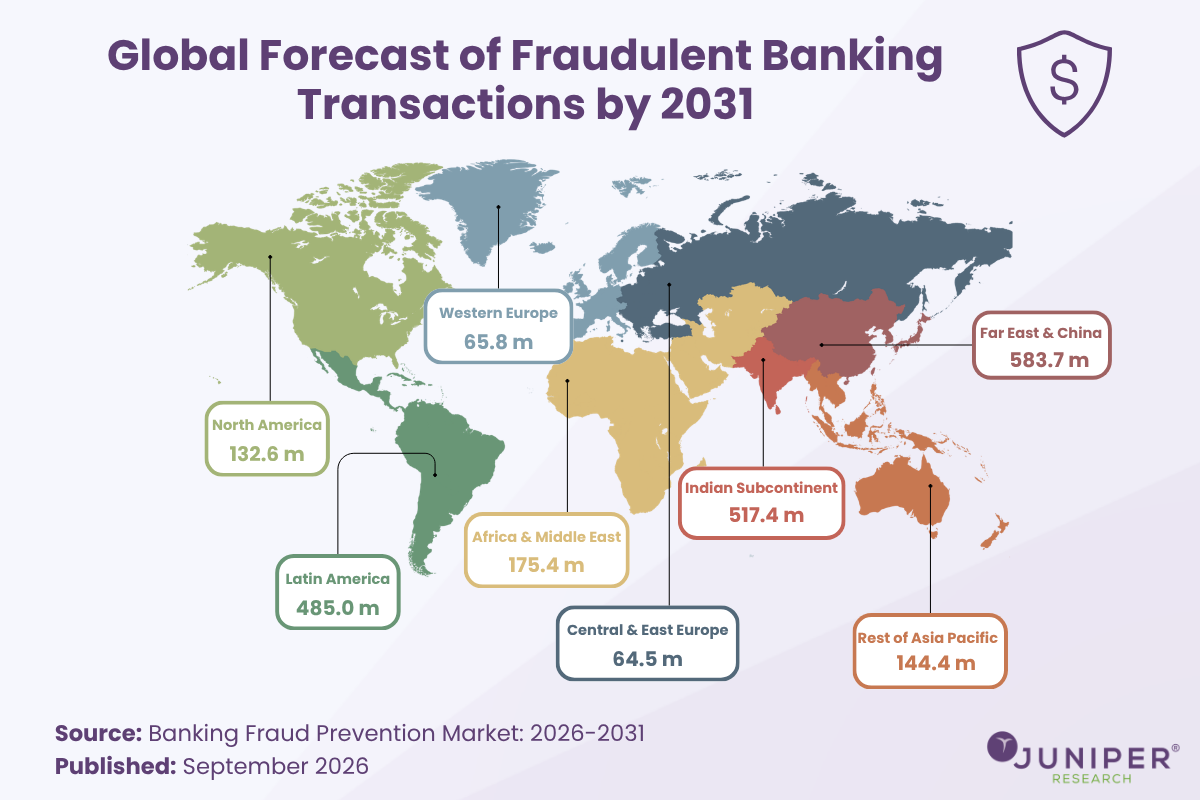
These tools are especially important as the number of fraudulent transactions seem to be on a rise, globally. The total number of fraudulent transactions across digital banking and money transfers is expected to reach 2.2 billion in 2031; up from 773.7 million in 2026. This represents a 180.3% increase over the forecast period; highlighting the scale and pace at which digital fraud is expected to grow.
About the Infographic
The infographic explores how the number of fraudulent transactions across digital banking and money transfers is expected to evolve by 2031, with the data broken down across regions worldwide.
According to the infographic, Far East & China is projected to record the highest number of fraudulent transactions across digital banking and money transfers by 2031. This is largely driven by the region’s vast digital payments market, which is supported by its large population and widespread adoption of mobile payment platforms. In China alone, total mobile payment transactions surpassed $43 trillion in 2024; driven primarily by dominant ecosystems such as Alipay and WeChat Pay.
Meanwhile, the Indian Subcontinent is forecast to experience the fastest growth in fraudulent transactions, with the number expected to reach 517.4 million by 2031. This sharp increase is primarily linked to the rapid growth of money transfers, alongside the widespread adoption of mobile money services across emerging markets in the region.
North America is anticipated to experience the slowest growth in fraudulent transactions; reaching 132.6 million by 2031. The region is expected to have 98.6% of banks and credit unions adopting fraud detection and prevention solutions by 2031 – a level of market maturity significantly higher than that of most emerging markets. This greater baseline of defensive coverage is expected to help suppress the rate at which new fraudulent activity successfully reaches customers and financial institutions.
Source: Banking Fraud Prevention Market: 2026-2031
Read the Press Release: Banking Fraud to Reach 2.2 billion Transactions by 2031, Fuelled by Growing AI-enabled Attacks
Download the Whitepaper: The Fraud Frontier: Securing Banking in an AI-driven Era

Latest research, whitepapers & press releases
-
 ReportSeptember 2026Fintech & Payments
 Dr Manju ChhillarEmbedded Finance Market: 2026-2031
Embedded finance is one of the fastest-growing markets in financial services, and is about to accelerate even further. Our Embedded Finance Market research provides detailed analysis of the key drivers behind this growth, and what these mean for stakeholders in this market.
VIEW -
 ReportSeptember 2026IoT & Emerging Technology
 Thomas WilsonApplication Security Market: 2026-2031
Our Application Security research suite provides detailed analysis of this emerging market; allowing application security providers to gain an understanding of key security trends and challenges, potential growth opportunities, and the competitive environment.
VIEW -
 ReportSeptember 2026Fintech & Payments
 Shane O'SullivanBanking Fraud Prevention Market: 2026-2031
Our Banking Fraud Prevention research suite provides a comprehensive and in-depth analysis of the types of fraud currently impacting the banking sector, and the evolving methods that can be used to overcome them.
VIEW -
 ReportSeptember 2026Telecoms & Connectivity
 Nick MaynardPrivate LTE & 5G Networks Market: 2026-2031
Our Private LTE & 5G Networks research suite provides detailed and insightful analysis of this evolving market; enabling stakeholders - from private LTE & 5G network platform specialists, mobile network operators, and diversified technology companies - to understand future growth, key trends, and the competitive environment.
VIEW -
 ReportSeptember 2026Fintech & Payments
 Michael GreenwoodOmnichannel Payment Platform Market: 2026-2031
Our Omnichannel Payment Platform research provides detailed analysis of this rapidly emerging market; allowing omnichannel payment platform providers to gain an understanding of key payment trends and challenges, potential growth opportunities, and the competitive environment.
VIEW -
 ReportSeptember 2026IoT & Emerging Technology
Nick MaynardIdentity & Access Management Market: 2026-2031
ReportSeptember 2026IoT & Emerging Technology
Nick MaynardIdentity & Access Management Market: 2026-2031Our Identity & Access Management research suite provides detailed and insightful analysis of this evolving market; enabling stakeholders - from Identity & Access Management platform specialists, cybersecurity vendors, and diversified technology companies - to understand future growth, key trends, and the competitive environment.
VIEW


-
 WhitepaperSeptember 2026IoT & Emerging Technology
Thomas Wilson
WhitepaperSeptember 2026IoT & Emerging Technology
Thomas WilsonVibe Coding: The Fastest-growing Threat to Application Security Today
Our complimentary whitepaper, Vibe Coding: The Fastest-growing Threat to Application Security Today, examines the state of the application security market; considering its impact on different verticals, and how it is being employed in these verticals to best combat malicious attackers and keep sensitive data safe.
VIEW -
 WhitepaperSeptember 2026Fintech & Payments
Shane O'Sullivan
WhitepaperSeptember 2026Fintech & Payments
Shane O'SullivanThe Fraud Frontier: Securing Banking in an AI-driven Era
Our complimentary whitepaper, The Fraud Frontier: Securing Banking in an AI-driven Era, examines the rapidly evolving state of the banking fraud prevention market.
VIEW -
 WhitepaperSeptember 2026Telecoms & Connectivity
Nick Maynard
WhitepaperSeptember 2026Telecoms & Connectivity
Nick MaynardHow Private Cellular Networks Are Unlocking Industry 4.0
Our complimentary whitepaper, How Private Cellular Networks Are Unlocking Industry 4.0, examines how private LTE & 5G networks are reshaping the way industry works.
VIEW -
 WhitepaperSeptember 2026Fintech & Payments
Michael Greenwood
WhitepaperSeptember 2026Fintech & Payments
Michael GreenwoodHow Omnichannel Payment Platforms Are Streamlining Merchant Operations
Our complimentary whitepaper, How Omnichannel Payment Platforms Are Streamlining Merchant Operations, examines how merchants are utilising omnichannel payment platforms to capitalise on customer data and integration with other business management software in order to minimise inefficiency.
VIEW -
 WhitepaperSeptember 2026Telecoms & Connectivity
 Jawad Jahan
Beyond the Headlines: What the 'AI Bubble' Really Means
Our complimentary whitepaper, Beyond the Headlines – What the 'AI Bubble' Really Means, analyses the scale and structure of AI infrastructure investment in the West, and the channels through which it could transmit stress to the wider financial system.
VIEW -
 WhitepaperSeptember 2026IoT & Emerging Technology
Nick Maynard
WhitepaperSeptember 2026IoT & Emerging Technology
Nick MaynardNon-human Identities ~ Transforming Identity & Access Management
Our complimentary whitepaper, Non-human Identities ~ Transforming Identity & Access Management, examines how non-human identities are revolutionising the Identity & Access Management market.
VIEW


-
Fintech & Payments
Embedded Finance Revenue to Reach $617 Billion Globally by 2031, as B2B Revenue Surges 390%
September 2026 -
IoT & Emerging Technology
AppSec Enterprise Spend to Approach $13 Billion Globally by 2031, as Market Leaders Revealed in New Competitor Leaderboard
September 2026 -
Fintech & Payments
Banking Fraud to Reach 2.2 billion Transactions by 2031, Fuelled by Growing AI-enabled Attacks
September 2026 -
Telecoms & Connectivity
Private Network Spend to Exceed $84 Billion Globally by 2031, as Market Leaders Set to Capitalise
September 2026 -
Fintech & Payments
The 6th Financial Innovation Forum – Payments & RegTech Arrives in London
September 2026 -
Fintech & Payments
Omnichannel Payment Platform Revenue to Exceed $100 Billion Globally by 2031, as Leading Platforms Set to Capitalise Are Revealed
September 2026