How Does CPaaS Traffic Revenue Vary Across Key Sectors?

Communications Platform-as-a-Service (CPaaS) players must ensure they can deliver traffic across the largest variety of customer communication channels, to attract the highest-spending clients. However, as these channels become increasingly complex, the provision of managed services is likely to play a big role in an enterprise’s decision regarding which CPaaS vendor to use.
Historically, SMS has been the predominant source of revenue for CPaaS players; generating a high volume of traffic each year, especially for authentication use cases. However, SMS can no longer be relied on by CPaaS players for future growth potential. We forecast that, in certain use cases, Application-to-Person (A2P) SMS will have already started to fall; being replaced by over-the-top (OTT), Rich Communication Services (RCS), or mobile identity services.
As the CPaaS market progresses, CPaaS players must invest in technologies that will expand their service offerings; enabling them to support rich media channel capabilities, and provide tools to automate customer conversations across channels. This will be essential to CPaaS players being able to create added value for enterprises with rich media messaging.
About the Infographic
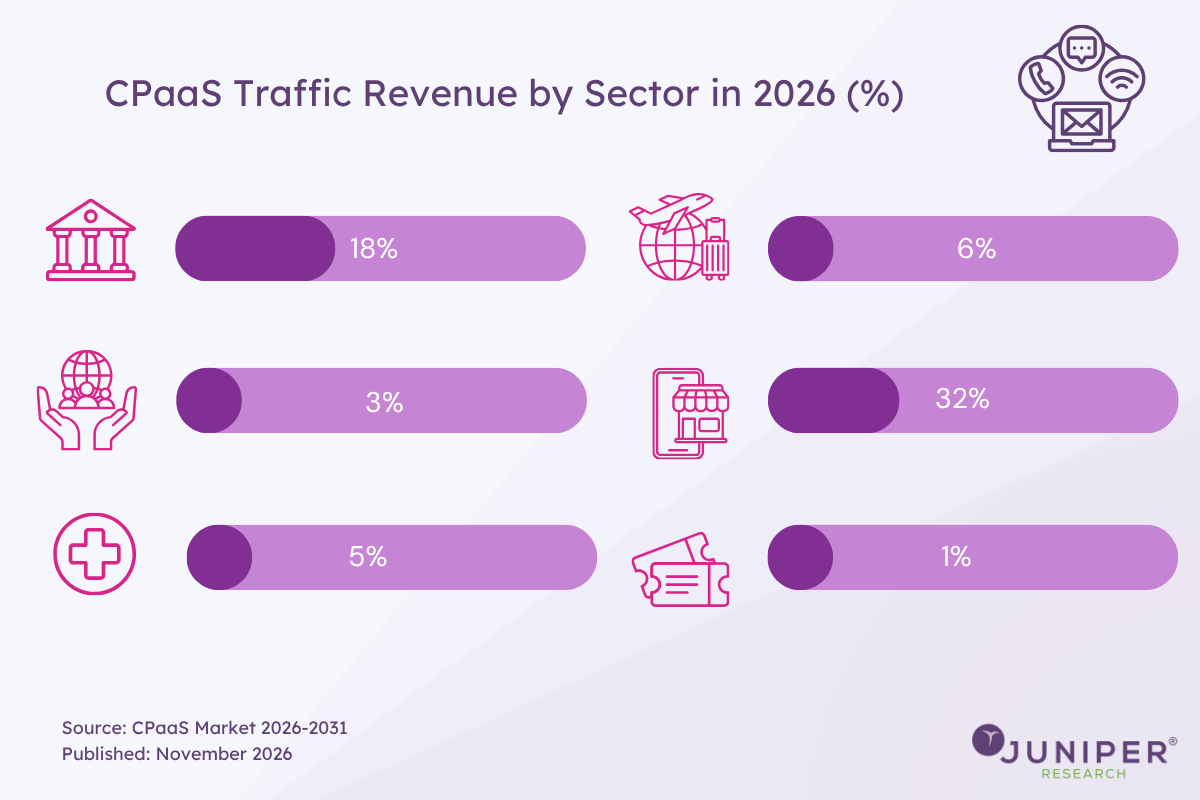
The graph illustrates the distribution of CPaaS traffic revenue across six different industry sectors in 2026.
The retail & eCommerce industry is expected to account for the largest share; contributing 32% of total revenue. This highlights the sector's significant reliance on CPaaS solutions to facilitate customer engagement, including messaging, notifications, and other communication services.
Banking services represents the second-largest contributor; accounting for 18% of revenue. This reflects the importance of CPaaS in supporting financial transactions, customer notifications, and secure communications.
Travel & tourism is projected to contribute 6% of CPaaS traffic revenue in 2026. While healthcare accounts for a slightly smaller share of 5%. Both sectors use communication platforms to improve customer interactions and streamline service delivery. In travel, CPaaS supports booking confirmations, itinerary updates, and service notifications, while healthcare providers use these solutions for appointment reminders, patient communications, and other administrative interactions.
The remaining sectors account for comparatively smaller shares of revenue. Government and public services is expected to contribute 3%, while the ticketing sector represents just 1%. Although these industries account for a smaller proportion of overall CPaaS traffic revenue, they continue to present opportunities for communication service providers.
This distribution highlights the dominance of retail and banking in CPaaS traffic revenue, with other sectors contributing smaller, but relevant, shares to the market.
Source: CPaaS Market: 2026-2031
Read the Press Release: CPaaS Market Value to Exceed $50 Billion Globally by 2031, as Infobip, Twilio, and Sinch Identified as Market Leaders
Download the Whitepaper: Rich Messaging, Real Growth: the Rise of RCS and OTT in CPaaS
Latest research, whitepapers & press releases
-
 ReportNovember 2026Fintech & Payments
 Shane O'Sullivan
B2B Payments Market: 2026-2031
Our B2B Payments research suite provides a wide-ranging and rigorous analysis of this massive market; enabling stakeholders from B2B payment platform providers to regulators and banks, to understand future growth, key trends and the competitive environment.
VIEW -
 ReportNovember 2026Telecoms & Connectivity
 Ardit Ballhysa
Robocalling & Branded Calling Market: 2026-2031
Our Robocalling & Branded Calling Market research suite provides insightful analysis of a market that is becoming increasingly dynamic and complex.
VIEW -
 ReportNovember 2026Telecoms & Connectivity
 Peter Boyland
CPaaS Market: 2026-2031
Our CPaaS Market 2026-2031 research suite delivers insightful analysis of a market that will experience significant growth in the next five years. It provides an analysis of CPaaS vendors, key partnerships and client relationships, alongside intelligence on how to capitalise on changing market dynamics within the rapidly expanding CPaaS market.
VIEW -
 ReportOctober 2026Fintech & Payments
 Michael Greenwood
Accounts Payable Automation Market: 2026-2031
Our Accounts Payable (AP) Automation research suite provides an insightful analysis of this rapidly growing market; enabling stakeholders to understand future growth, key trends and the competitive environment.
VIEW -
 ReportOctober 2026Fintech & Payments
 Jawad Jahan
Crypto-gaming Market: 2026-2035
Our Crypto-gaming Market research suite provides an insightful analysis of this rapidly growing market; enabling stakeholders - from crypto-gaming and sportsbooks operators, prediction market platforms, business-to-business (B2B) gambling platforms and software providers, to crypto payment processors and regulators - to understand future growth, key trends, and the competitive environment.
VIEW -
 ReportOctober 2026Telecoms & Connectivity
 Alex Webb
Retail Roaming Market: 2026-2031
Our Retail Roaming research suite for mobile network operators (MNOs) and mobile virtual network operators (MVNOs) provides detailed analysis and strategic recommendations for the next era of retail roaming.
VIEW


-
 WhitepaperNovember 2026Telecoms & Connectivity
Ardit Ballhysa
Deepfakes in Robocalling Fraud – the Need for Advanced Solutions and Frameworks in 2027 and Beyond
Our complimentary whitepaper, Deepfakes in Robocalling Fraud – the Need for Advanced Solutions and Frameworks in 2027 and Beyond, explores the challenges and opportunities for fraud prevention.
VIEW -
 WhitepaperNovember 2026Telecoms & Connectivity
Peter Boyland
Rich Messaging, Real Growth: the Rise of RCS and OTT in CPaaS
Our complimentary whitepaper, Rich Messaging, Real Growth: the Rise of RCS and OTT in CPaaS, explores the challenges and opportunities for operators and enterprises as CPaaS becomes more embedded in the consumer experience.
VIEW -
 WhitepaperOctober 2026Fintech & Payments
Michael Greenwood
Accounts Payable Automation ~ How Businesses Are Reducing Operational Costs
Our complimentary whitepaper, Accounts Payable Automation ~ How Businesses Are Reducing Operational Costs, analyses how AP automation is combatting costs by decreasing the need for manual processes, and provides strategic insight into a number of key trends in the AP automation space.
VIEW -
 WhitepaperOctober 2026Fintech & Payments
Jawad Jahan
Compliance or Anonymity - The Crypto-gaming Operator’s Dilemma
Our complimentary whitepaper, Compliance or Anonymity - The Crypto-gaming Operator’s Dilemma, analyses the current regulatory landscape of the crypto-gaming market.
VIEW -
 WhitepaperOctober 2026Telecoms & Connectivity
Alex Webb
Reimagining the Future of Retail Roaming – How Mobile Network Operators Must Adapt
Our complimentary whitepaper, Reimagining the Future of Retail Roaming – How Mobile Network Operators Must Adapt, explores the emerging opportunities for MNOs within retail roaming.
VIEW -
 WhitepaperSeptember 2026Fintech & Payments
 Dr Manju Chhillar
Emerging Markets: The Next Opportunity for Embedded Finance
This free whitepaper examines how a combination of multiple factors is driving North America towards saturation for embedded finance.
VIEW


-
Fintech & Payments
27th NextGen Payments & RegTech Forum Returns to Limassol, Cyprus
November 2026 -
Telecoms & Connectivity
Consumer Losses from Fraudulent Robocalls to Fall by a Third in North America by 2031; Driven by Robust Solutions and Branded Calling
November 2026 -
Telecoms & Connectivity
CPaaS Market Value to Exceed $50 Billion Globally by 2031, as Infobip, Twilio, and Sinch Identified as Market Leaders
November 2026 -
Fintech & Payments
26th NextGen Payments & RegTech Forum Arrives in Austin, Texas
October 2026 -
Fintech & Payments
Financial Institutions to Spend Over $66.2 Billion Globally on Fraud Prevention by 2031, Driven by Growing Demand for Cross-industry Fraud Intelligence
October 2026 -
Identity & Security
Identity & Access Management Spend to Exceed $40 Billion Globally by 2031, Driven by AI Benefits & Risks
October 2026