How Are Operator Networks Using LLMs?

As telecom networks become more software-defined and data-driven, the pressure is on operators to boost efficiency, reduce downtime, and stay ahead of increasingly complex demands.
Our latest research has identified several key ways that large language models (LLMs) are now stepping into the telecom space; not as chatbots, but as intelligent agents capable of transforming network operations:
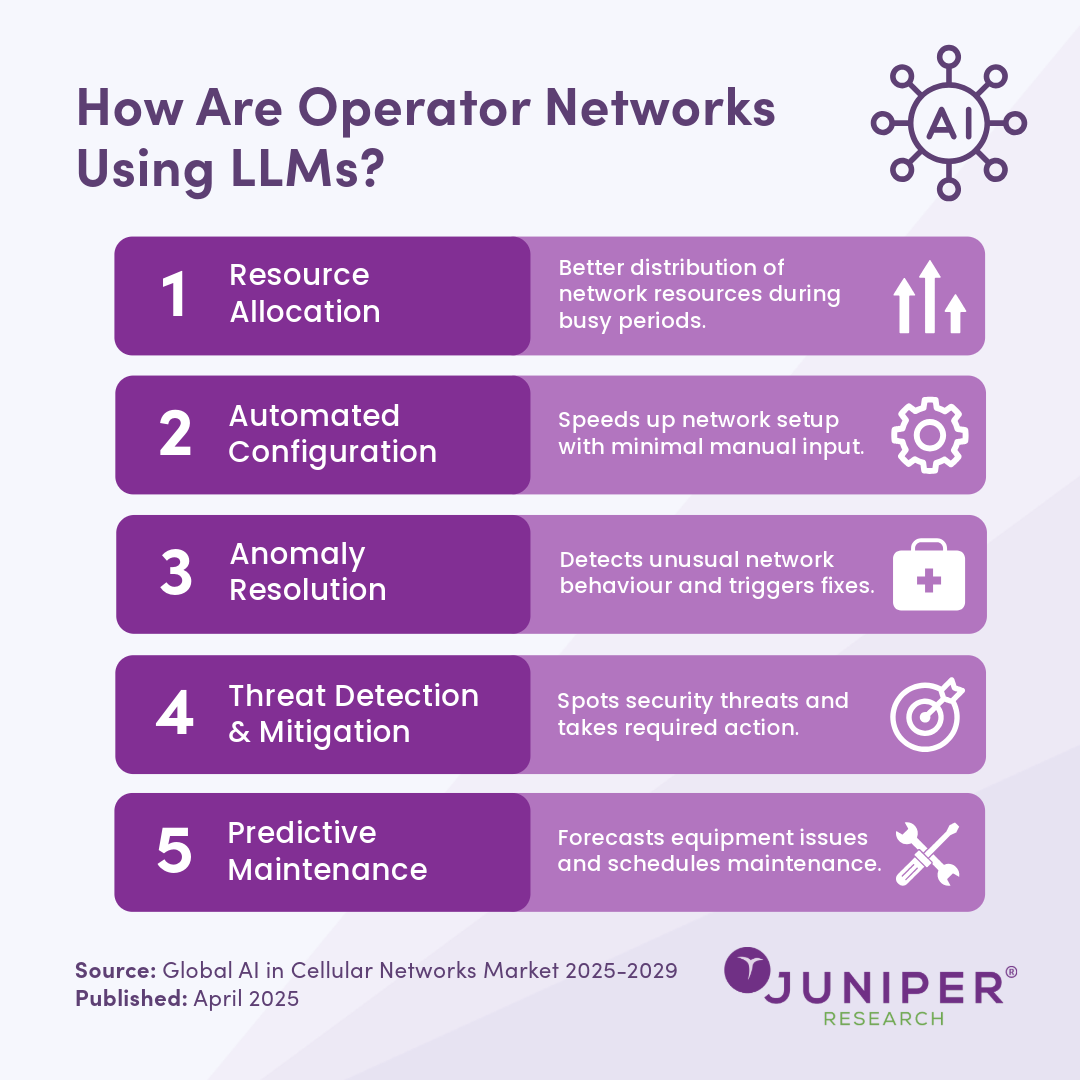
Resource Allocation
At the heart of any telecom network is the challenge of resource allocation; ensuring bandwidth, compute, and spectrum are distributed effectively to match user demand.
LLMs help operators take this to the next level by continuously analysing real-time network data and traffic patterns. By understanding fluctuations in usage, they can proactively reallocate resources to high-demand areas, balancing loads and preventing bottlenecks. This results in better network performance, particularly during peak times, without overspending on capacity that may go unused.
Network Configuration
Manual configuration of network parameters is time-consuming, error-prone, and increasingly impractical in large-scale, dynamic environments.
LLMs enable automated configuration by interpreting documentation, learning from past setups, and adjusting parameters to match current needs. Whether deploying new sites or reoptimising existing infrastructure, LLMs can streamline this entire process; resulting in faster rollouts, fewer configuration errors, and a lighter workload for network engineers.
Anomaly Detection and Resolution
Network anomalies, from signal interference to routing failures, can severely impact service quality - and go undetected by traditional network maintenance systems.
LLMs, however, excel at identifying patterns and spotting irregularities in complex datasets. By continuously learning from network logs and behaviours, they can detect anomalies as they emerge, diagnose the root cause, and either trigger an automated fix or provide engineers with clear, actionable recommendations. This dramatically reduces MTTR and helps maintain high service availability.
Threat Detection and Mitigation
With cyberattacks on the rise, operators are under pressure to secure their networks in real time.
LLMs play a vital role here by spotting unusual traffic behaviours and correlating signals across diverse data sources - from network logs to system alerts. Unlike traditional security tools that rely on known signatures, LLMs can identify novel threats based on behavioural anomalies. This allows them to flag potential intrusions early and recommend mitigation strategies or automatically activate protective protocols; resulting in a more agile and adaptive security posture.
Predictive Maintenance
Downtime is costly - and often preventable. LLMs can process vast amounts of historical performance and maintenance data to predict when components are likely to fail.
Whether it’s detecting overheating in base stations or identifying early signs of fibre degradation, LLMs enable operators to act before issues cause outages. By integrating with maintenance systems, they can also schedule proactive repairs and automatically generate work orders, minimising disruption and extending the lifespan of critical infrastructure.
These five capabilities only scratch the surface of what LLMs can offer. As networks evolve to support 5G, edge computing, and even early 6G experimentation, the need for adaptive, intelligent operations will only grow - and when combined with other AI models and real-time analytics, are well-positioned to become the decision-making engine behind next-generation networks.
Source: Global AI in Cellular Networks Market 2025-2029
Download the Whitepaper: 3 Key Trends Driving Operator Investment in Cellular Network AI in 2025
Read the Press Release: Operator AI Investment to Exceed $86bn Over the Next Four Years as ‘Zero Touch’ Becomes the Focus

Latest research, whitepapers & press releases
-
 ReportOctober 2026Fintech & Payments
 Michael GreenwoodAccounts Payable Automation Market: 2026-2031
Our Accounts Payable (AP) Automation research suite provides an insightful analysis of this rapidly growing market; enabling stakeholders to understand future growth, key trends and the competitive environment.
VIEW -
 ReportOctober 2026Fintech & Payments
 Jawad JahanCrypto-gaming Market: 2026-2035
Our Crypto-gaming Market research suite provides an insightful analysis of this rapidly growing market; enabling stakeholders - from crypto-gaming and sportsbooks operators, prediction market platforms, business-to-business (B2B) gambling platforms and software providers, to crypto payment processors and regulators - to understand future growth, key trends, and the competitive environment.
VIEW -
 ReportOctober 2026Telecoms & Connectivity
 Alex WebbRetail Roaming Market: 2026-2031
Our Retail Roaming research suite for mobile network operators (MNOs) and mobile virtual network operators (MVNOs) provides detailed analysis and strategic recommendations for the next era of retail roaming.
VIEW -
 ReportSeptember 2026Fintech & Payments
 Dr Manju ChhillarEmbedded Finance Market: 2026-2031
Embedded finance is one of the fastest-growing markets in financial services, and is about to accelerate even further. Our Embedded Finance Market research provides detailed analysis of the key drivers behind this growth, and what these mean for stakeholders in this market.
VIEW -
 ReportSeptember 2026Identity & Security
 Thomas WilsonApplication Security Market: 2026-2031
Our Application Security research suite provides detailed analysis of this emerging market; allowing application security providers to gain an understanding of key security trends and challenges, potential growth opportunities, and the competitive environment.
VIEW -
 ReportSeptember 2026Fintech & Payments
 Shane O'SullivanBanking Fraud Prevention Market: 2026-2031
Our Banking Fraud Prevention research suite provides a comprehensive and in-depth analysis of the types of fraud currently impacting the banking sector, and the evolving methods that can be used to overcome them.
VIEW


-
 WhitepaperOctober 2026Fintech & Payments
Michael Greenwood
WhitepaperOctober 2026Fintech & Payments
Michael GreenwoodAccounts Payable Automation ~ How Businesses Are Reducing Operational Costs
Our complimentary whitepaper, Accounts Payable Automation ~ How Businesses Are Reducing Operational Costs, analyses how AP automation is combatting costs by decreasing the need for manual processes, and provides strategic insight into a number of key trends in the AP automation space.
VIEW -
 WhitepaperOctober 2026Fintech & Payments
Jawad Jahan
WhitepaperOctober 2026Fintech & Payments
Jawad JahanCompliance or Anonymity - The Crypto-gaming Operator’s Dilemma
Our complimentary whitepaper, Compliance or Anonymity - The Crypto-gaming Operator’s Dilemma, analyses the current regulatory landscape of the crypto-gaming market.
VIEW -
 WhitepaperOctober 2026Telecoms & Connectivity
Alex Webb
WhitepaperOctober 2026Telecoms & Connectivity
Alex WebbReimagining the Future of Retail Roaming – How Mobile Network Operators Must Adapt
Our complimentary whitepaper, Reimagining the Future of Retail Roaming – How Mobile Network Operators Must Adapt, explores the emerging opportunities for MNOs within retail roaming.
VIEW -
 WhitepaperSeptember 2026Fintech & Payments
Dr Manju Chhillar
WhitepaperSeptember 2026Fintech & Payments
Dr Manju ChhillarEmerging Markets: The Next Opportunity for Embedded Finance
This free whitepaper examines how a combination of multiple factors is driving North America towards saturation for embedded finance.
VIEW -
 WhitepaperSeptember 2026Emerging Technology
Thomas Wilson
WhitepaperSeptember 2026Emerging Technology
Thomas WilsonVibe Coding: The Fastest-growing Threat to Application Security Today
Our complimentary whitepaper, Vibe Coding: The Fastest-growing Threat to Application Security Today, examines the state of the application security market; considering its impact on different verticals, and how it is being employed in these verticals to best combat malicious attackers and keep sensitive data safe.
VIEW -
 WhitepaperSeptember 2026Fintech & Payments
Shane O'Sullivan
WhitepaperSeptember 2026Fintech & Payments
Shane O'SullivanThe Fraud Frontier: Securing Banking in an AI-driven Era
Our complimentary whitepaper, The Fraud Frontier: Securing Banking in an AI-driven Era, examines the rapidly evolving state of the banking fraud prevention market.
VIEW


-
Fintech & Payments
26th NextGen Payments & RegTech Forum Arrives in Austin, Texas
October 2026 -
Fintech & Payments
Financial Institutions to Spend Over $66.2 Billion Globally on Fraud Prevention by 2031, Driven by Growing Demand for Cross-industry Fraud Intelligence
October 2026 -
Fintech & Payments
Omnichannel Payment Platforms to See a Dramatic 172% Growth in the Value of Transactions Processed Globally by 2031, as Merchants Capitalise on Payment Data
October 2026 -
Fintech & Payments
Accounts Payable Automation to Save Global Businesses 6.2 Billion Hours by 2031, Accelerated by Business System Integration
October 2026 -
Fintech & Payments
The 25th NextGen Payments & RegTech Forum Arrives in Athens, Greece
October 2026 -
Fintech & Payments
Crypto Gaming: Wagers to Reach $1.3 Trillion by 2035, as Crypto Rails Widen Global Access Despite Regulatory Challenges
October 2026