What Do Trump's Tariffs Mean for Telecoms & 6G?

(UPDATE: On April 9th, Donald Trump announced a 90-day pause on higher US tariffs for affected countries, introducing instead a universal “reciprocal tariff” of 10%. However, tariffs on Chinese imports were raised sharply to 145%.)
Last week, the Trump Administration introduced sweeping new tariffs, marking a major shift in its international trade policy. These tariffs are set to significantly impact both the US economy and global trade, despite being announced only recently. They impose a minimum 10% tax on all imported goods, with some countries facing even higher rates.
Tariffs Imposed by the US in April 2025 (%)
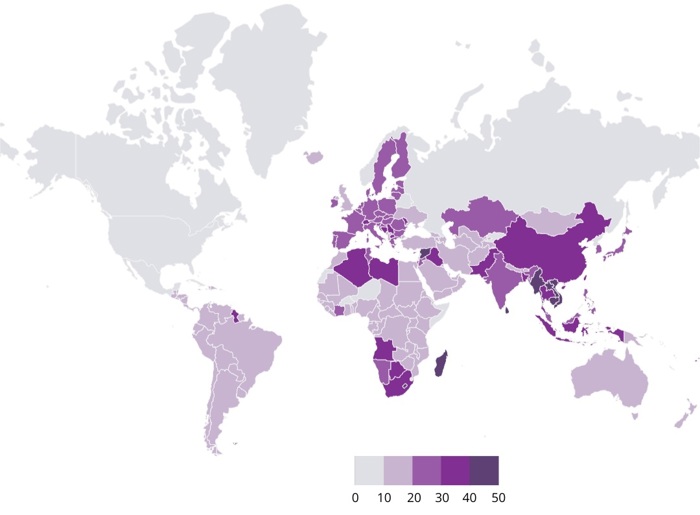
Source: White House
In response, nations including China, Canada, and the European Union have revealed plans to impose their own tariffs on the US, fuelling concerns over a potential ‘trade war’ between some of the world’s largest economies. Large US companies, particularly those dependent on international supply chains, stand to lose the most from these new measures. In the tech sector, firms like Apple and Microsoft, which rely on multiple components for their devices, have already seen sharp declines in share prices.
While these tariffs will undoubtedly disrupt global supply chains, telecoms network hardware is a unique case. With high-value, low-volume trade, telecom operators typically make infrequent, large purchases. Given the small number of vendors in the market, we don’t expect operators to benefit from switching to new hardware suppliers. Huawei, Ericsson, Nokia, ZTE, and Samsung account for more than 90% of the global market share. Operators have already been banned from using Huawei and ZTE equipment in various regions, and local players often lack the production capacity to meet demand. As a result, operators have little choice but to bear the cost of these tariffs.
The Immediate Impact on US Telecom Operators
These tariffs have immediately driven up costs for vendors in the US, but network operators are in a somewhat unique position. The major players in the country - AT&T, T-Mobile, and Verizon - operate in a highly standardised industry with a limited pool of vendors to choose from when upgrading their networks. Although the first commercial 5G launch in the US took place in 2019, operators continue to upgrade existing 5G networks as they focus on rolling out services aimed at attracting enterprise clients.
The key question across industries is how much of these cost increases will be passed on to the end user. For telecoms, we expect operators to pass the higher costs of network upgrades and maintenance onto mobile subscribers, driven by the slim profit margins tied to consumer subscriptions. US operators have also been focused on reducing their total cost of ownership (TCO) for networks, a key factor in the standardisation of 5G networks.
Impact on 6G Development and the Road Ahead
However, these tariffs come at a pivotal time for telecoms, as the development of 6G networks has just begun. Industry bodies like 3GPP, the International Telecommunication Union (ITU), and the European Telecommunications Standards Institute (ETSI) have already started discussing the technical requirements for 6G. The expected revenue boost from 5G has yet to materialise, with many operators still struggling to secure a return on their 5G investments; a mistake they cannot afford to repeat with 6G.
When 5G was first discussed, there was a strong focus on identifying ‘killer apps’ - use cases that would generate additional revenue for operators. However, the technology launched without a clear vision of what those use cases would be, leaving operators grappling with the challenge of securing a return on investment.
Looking ahead, Juniper Research believes that with 6G, operators will place greater emphasis on business models that attract high-spending enterprise clients. Moreover, they must aim to own the direct billing relationship for both services and connectivity, rather than simply acting as a ‘connectivity pipe’ in a B2B2C capacity.
But how do these tariffs impact 6G development? First, we need to consider the timelines for 6G and the timing of the next presidential election. Based on previous telecom network cycles and announcements from industry bodies, we expect network testing to begin around 2028, with a commercial launch in 2029; right at the end of the next election cycle.
If the tariffs are still in place by then, we anticipate that US operators will take a more cautious approach to 6G, potentially delaying the commercial launch as they seek to minimise investment costs. Given the lessons learned from 5G monetisation and the need for more evolved business models in 6G, these tariffs add another challenge for operators striving to maximise telecom service revenue.
As VP of Telecoms Market Research at Juniper Research, Sam produces high-quality research on telecommunications technologies and the future of digital content. His recent reports include Direct-to-Cell, Operator Revenue Strategies, and CPaaS.
Related Research
-
 ReportMay 2026Telecoms & Connectivity
 Alex Webb6G Market, 2026-2035
Our 6G Market research suite provides detailed analysis and strategic recommendations for mobile network operators developing their 6G roadmaps in the build up to its standardisation and launch.
VIEW -
 ReportMay 2025Telecoms & Connectivity
 Fred SavageOperator Revenue Strategies Market, 2025-2029
Discover invaluable insights into trends and strategies for network operator revenue in our latest report, Network Operator Revenue Strategies. With data split across 60 countries, this extensive forecast analyses the dynamic and competitive network operator market and the current market challenges posed by slowing revenue, high market saturation in the consumer market, rising network ownership costs, and challenges in 5G monetisation.
VIEW -
 ReportJanuary 2025Future Leaders 100
 Sam BarkerFuture Leaders 100, Telecoms 2025
Our Future Leaders 100: Telecoms 2025 research suite is dedicated to identifying the most innovative start-ups within telecoms and connectivity which have the disruptive potential to reshape the industry.
VIEW
Latest research, whitepapers & press releases
-
 ReportOctober 2026Fintech & Payments
 Michael GreenwoodAccounts Payable Automation Market: 2026-2031
Our Accounts Payable (AP) Automation research suite provides an insightful analysis of this rapidly growing market; enabling stakeholders to understand future growth, key trends and the competitive environment.
VIEW -
 ReportOctober 2026Fintech & Payments
 Jawad JahanCrypto-gaming Market: 2026-2035
Our Crypto-gaming Market research suite provides an insightful analysis of this rapidly growing market; enabling stakeholders - from crypto-gaming and sportsbooks operators, prediction market platforms, business-to-business (B2B) gambling platforms and software providers, to crypto payment processors and regulators - to understand future growth, key trends, and the competitive environment.
VIEW -
 ReportOctober 2026Telecoms & Connectivity
 Alex WebbRetail Roaming Market: 2026-2031
Our Retail Roaming research suite for mobile network operators (MNOs) and mobile virtual network operators (MVNOs) provides detailed analysis and strategic recommendations for the next era of retail roaming.
VIEW -
 ReportSeptember 2026Fintech & Payments
 Dr Manju ChhillarEmbedded Finance Market: 2026-2031
Embedded finance is one of the fastest-growing markets in financial services, and is about to accelerate even further. Our Embedded Finance Market research provides detailed analysis of the key drivers behind this growth, and what these mean for stakeholders in this market.
VIEW -
 ReportSeptember 2026Identity & Security
 Thomas WilsonApplication Security Market: 2026-2031
Our Application Security research suite provides detailed analysis of this emerging market; allowing application security providers to gain an understanding of key security trends and challenges, potential growth opportunities, and the competitive environment.
VIEW -
 ReportSeptember 2026Fintech & Payments
 Shane O'SullivanBanking Fraud Prevention Market: 2026-2031
Our Banking Fraud Prevention research suite provides a comprehensive and in-depth analysis of the types of fraud currently impacting the banking sector, and the evolving methods that can be used to overcome them.
VIEW


-
 WhitepaperOctober 2026Fintech & Payments
Jawad Jahan
WhitepaperOctober 2026Fintech & Payments
Jawad JahanCompliance or Anonymity - The Crypto-gaming Operator’s Dilemma
Our complimentary whitepaper, Compliance or Anonymity - The Crypto-gaming Operator’s Dilemma, analyses the current regulatory landscape of the crypto-gaming market.
VIEW -
 WhitepaperOctober 2026Telecoms & Connectivity
Alex Webb
WhitepaperOctober 2026Telecoms & Connectivity
Alex WebbReimagining the Future of Retail Roaming – How Mobile Network Operators Must Adapt
Our complimentary whitepaper, Reimagining the Future of Retail Roaming – How Mobile Network Operators Must Adapt, explores the emerging opportunities for MNOs within retail roaming.
VIEW -
 WhitepaperSeptember 2026Fintech & Payments
Dr Manju Chhillar
WhitepaperSeptember 2026Fintech & Payments
Dr Manju ChhillarEmerging Markets: The Next Opportunity for Embedded Finance
This free whitepaper examines how a combination of multiple factors is driving North America towards saturation for embedded finance.
VIEW -
 WhitepaperSeptember 2026Emerging Technology
Thomas Wilson
WhitepaperSeptember 2026Emerging Technology
Thomas WilsonVibe Coding: The Fastest-growing Threat to Application Security Today
Our complimentary whitepaper, Vibe Coding: The Fastest-growing Threat to Application Security Today, examines the state of the application security market; considering its impact on different verticals, and how it is being employed in these verticals to best combat malicious attackers and keep sensitive data safe.
VIEW -
 WhitepaperSeptember 2026Fintech & Payments
Shane O'Sullivan
WhitepaperSeptember 2026Fintech & Payments
Shane O'SullivanThe Fraud Frontier: Securing Banking in an AI-driven Era
Our complimentary whitepaper, The Fraud Frontier: Securing Banking in an AI-driven Era, examines the rapidly evolving state of the banking fraud prevention market.
VIEW -
 WhitepaperSeptember 2026Telecoms & Connectivity
 Nick Maynard
How Private Cellular Networks Are Unlocking Industry 4.0
Our complimentary whitepaper, How Private Cellular Networks Are Unlocking Industry 4.0, examines how private LTE & 5G networks are reshaping the way industry works.
VIEW


-
Fintech & Payments
The 25th NextGen Payments & RegTech Forum Arrives in Athens, Greece
October 2026 -
Fintech & Payments
Crypto Gaming: Wagers to Reach $1.3 Trillion by 2035, as Crypto Rails Widen Global Access Despite Regulatory Challenges
October 2026 -
Fintech & Payments
Juniper Research Unveils Identity & Security Award Winners for 2026
October 2026 -
Retail Roaming Revenue to Fall $4 Billion By 2031, as Regulatory Restrictions and Competition Bite
October 2026 -
Fintech & Payments
Soft POS to Surpass 100 Million Installations in 2030
September 2026 -
Fintech & Payments
The NextGen Payments & RegTech Forum Arrives in Dubai
September 2026