Travel eSIMs Are Cleared for Take Off - But Are Operators Ready?

Roaming has been a proven connectivity solution in telecoms markets since the 1980s. While cellular technologies have evolved during this time, the emergence of travel eSIM packages can be considered the first service that genuinely has the potential to substantially disrupt this established market, since roaming services began over 30 years ago.
As the demand for staying connected while abroad grows, this disruptive business model is emerging to challenge the traditional international roaming and travel connectivity market. Travel eSIMs, also known as embedded SIMs, now offer alternative travel connectivity solutions, lower cost and more flexibility to mobile subscribers.
The Time Is Now for Travel eSIMs
The number of eSIM-capable devices continues to grow, with most new smartphones compatible with the technology. In the US, the iPhone 14 and iPhone 15 models were launched as eSIM-only devices. This increases awareness of the technology and indicates that eSIM technologies will eventually replace the traditional plastic SIM cards widely used today.
Travel eSIMs give customers a significantly more cost-effective solution than traditional roaming services. By offering data at significantly lower costs than roaming, travel eSIMs can save customers an average of 35% on their data spend per GB in 2024. This financial empowerment makes travel eSIM packages a compelling choice for frequent travellers.
The demand for travel eSIMs is rising, particularly where operators impose high roaming charges. According to Juniper Research’s latest Travel SIMs & eSIMs report, the total revenue from travel eSIMs is projected to increase rapidly by 650% between 2024 and 2028. This rapid growth indicates an urgent need for telecom industry professionals, mobile subscribers, and individuals interested in travel connectivity solutions to adapt to the changing travel connectivity landscape.
As the potential value of this market becomes apparent, more vendors are expected to emerge to take their share of revenue. One of the latest entrants into the travel eSIM market is the digital bank Revolut, which became one of the first digital banks within the Economic European Area to launch an eSIM for connectivity in over 100 countries.
How Will Travel eSIM Vendors Ensure Success?
An increasing number of travellers are open to purchasing travel eSIMs to remain connected whilst abroad, with the number of travel eSIM users growing 52% between 2022 and 2023. However, with a lack of consumer awareness of the technology hindering further growth, how will travel eSIM vendors ensure that the market reaches its full potential?
Juniper Research has identified several strategies that travel eSIM vendors must use to capitalise on this rapidly growing market. These strategies must, first-and-foremost, focus on increasing awareness of travel eSIM products amongst international travellers through:
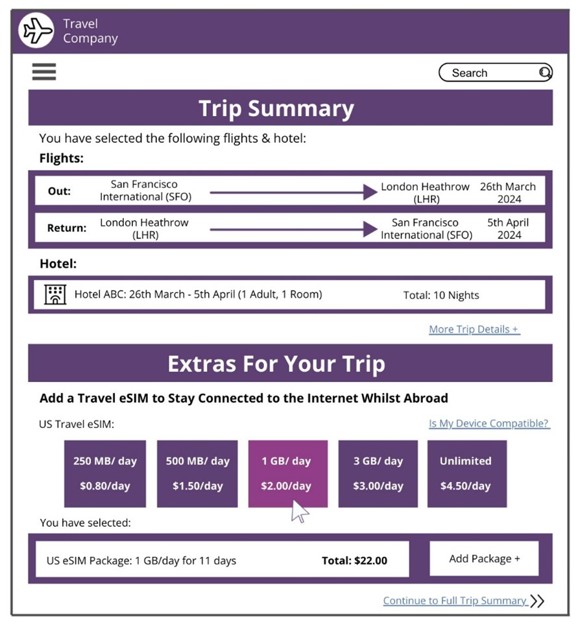
- Partnerships with Travel Operators: Vendors will partner with travel operators such as travel agencies or airlines. Travel operators have details about a customer’s trip, including the location and length, and are therefore in the prime position to offer personalised travel eSIM packages.
- Advertising Campaigns: Vendors will promote travel eSIM products through advertising campaigns to help increase awareness of the packages that are available.
- Value-added Services: Vendors will use value-added services, such as loyalty programmes, to incentivise customers to purchase a travel eSIM again when they next travel. Vendors may also use online queries to learn more about the customer’s travel information and data requirements.
The Impact on Roaming Vendors
Key issues for roaming vendors are the identification of roaming connections and traffic, and the lack of real-time data on roaming connections. This is becoming an even more significant problem as 5G roaming agreements come into place. The faster speeds and lower latency offered by 5G networks have led to higher demands from mobile subscribers, even when roaming. However, roaming services have not remained agile against this demand for data, with many roaming services unable to identify roaming connections and traffic, leading to ineffective and inaccurate billing.
However, despite the potential value of travel eSIMs, mobile roaming services still provide customers with some benefits:
- Increased Availability: Some operators have yet to support eSIMs for global connectivity, and many smartphone vendors do not support the necessary hardware. Roaming services are well established, with a greater number of operators offering them. Therefore, travellers can remain connected in more countries while roaming, when travel eSIM packages are unavailable.
- Convenience: Travel eSIMs require the customer to purchase and download the package before using it, whereas subscribers do not have to activate their device for connectivity. The customer also remains on their existing mobile number, so they can continue to receive calls and texts on this number.
While many may view travel eSIMs and roaming packages as competing technologies, this should not be the case. Offering consumers choice is essential to the provision of any successful service; therefore, we expect more operators to launch travel eSIM services alongside their roaming packages to compete with these emerging third-party vendors and protect their revenue.
Molly is a Research Analyst at Juniper Research, providing insight, data, and recommendations for established and future markets within the telecommunications sector. Her recent reports include Travel SIMs & eSIMs, Generative AI in Mobile Messaging, and A2P Messaging.
Related Research
-
 ReportOctober 2025Telecoms & Connectivity
 Molly GatfordTravel eSIM Market, 2025-2030
Our comprehensive Travel eSIMs research suite comprises detailed assessment of a market undergoing rapid growth. It provides insight into how travel eSIM providers can differentiate their services to maximise success in the market over the next two years.
VIEW
Latest research, whitepapers & press releases
-
 ReportOctober 2026Fintech & Payments
 Jawad JahanCrypto-gaming Market: 2026-2035
Our Crypto-gaming Market research suite provides an insightful analysis of this rapidly growing market; enabling stakeholders - from crypto-gaming and sportsbooks operators, prediction market platforms, business-to-business (B2B) gambling platforms and software providers, to crypto payment processors and regulators - to understand future growth, key trends, and the competitive environment.
VIEW -
 ReportOctober 2026Telecoms & Connectivity
 Alex WebbRetail Roaming Market: 2026-2031
Our Retail Roaming research suite for mobile network operators (MNOs) and mobile virtual network operators (MVNOs) provides detailed analysis and strategic recommendations for the next era of retail roaming.
VIEW -
 ReportSeptember 2026Fintech & Payments
 Dr Manju ChhillarEmbedded Finance Market: 2026-2031
Embedded finance is one of the fastest-growing markets in financial services, and is about to accelerate even further. Our Embedded Finance Market research provides detailed analysis of the key drivers behind this growth, and what these mean for stakeholders in this market.
VIEW -
 ReportSeptember 2026Identity & Security
 Thomas WilsonApplication Security Market: 2026-2031
Our Application Security research suite provides detailed analysis of this emerging market; allowing application security providers to gain an understanding of key security trends and challenges, potential growth opportunities, and the competitive environment.
VIEW -
 ReportSeptember 2026Fintech & Payments
 Shane O'SullivanBanking Fraud Prevention Market: 2026-2031
Our Banking Fraud Prevention research suite provides a comprehensive and in-depth analysis of the types of fraud currently impacting the banking sector, and the evolving methods that can be used to overcome them.
VIEW -
 ReportSeptember 2026Telecoms & Connectivity
 Nick MaynardPrivate LTE & 5G Networks Market: 2026-2031
Our Private LTE & 5G Networks research suite provides detailed and insightful analysis of this evolving market; enabling stakeholders - from private LTE & 5G network platform specialists, mobile network operators, and diversified technology companies - to understand future growth, key trends, and the competitive environment.
VIEW


-
 WhitepaperOctober 2026Fintech & Payments
Jawad Jahan
WhitepaperOctober 2026Fintech & Payments
Jawad JahanCompliance or Anonymity - The Crypto-gaming Operator’s Dilemma
Our complimentary whitepaper, Compliance or Anonymity - The Crypto-gaming Operator’s Dilemma, analyses the current regulatory landscape of the crypto-gaming market.
VIEW -
 WhitepaperOctober 2026Telecoms & Connectivity
Alex Webb
WhitepaperOctober 2026Telecoms & Connectivity
Alex WebbReimagining the Future of Retail Roaming – How Mobile Network Operators Must Adapt
Our complimentary whitepaper, Reimagining the Future of Retail Roaming – How Mobile Network Operators Must Adapt, explores the emerging opportunities for MNOs within retail roaming.
VIEW -
 WhitepaperSeptember 2026Fintech & Payments
Dr Manju Chhillar
WhitepaperSeptember 2026Fintech & Payments
Dr Manju ChhillarEmerging Markets: The Next Opportunity for Embedded Finance
This free whitepaper examines how a combination of multiple factors is driving North America towards saturation for embedded finance.
VIEW -
 WhitepaperSeptember 2026Emerging Technology
Thomas Wilson
WhitepaperSeptember 2026Emerging Technology
Thomas WilsonVibe Coding: The Fastest-growing Threat to Application Security Today
Our complimentary whitepaper, Vibe Coding: The Fastest-growing Threat to Application Security Today, examines the state of the application security market; considering its impact on different verticals, and how it is being employed in these verticals to best combat malicious attackers and keep sensitive data safe.
VIEW -
 WhitepaperSeptember 2026Fintech & Payments
Shane O'Sullivan
WhitepaperSeptember 2026Fintech & Payments
Shane O'SullivanThe Fraud Frontier: Securing Banking in an AI-driven Era
Our complimentary whitepaper, The Fraud Frontier: Securing Banking in an AI-driven Era, examines the rapidly evolving state of the banking fraud prevention market.
VIEW -
 WhitepaperSeptember 2026Telecoms & Connectivity
Nick Maynard
WhitepaperSeptember 2026Telecoms & Connectivity
Nick MaynardHow Private Cellular Networks Are Unlocking Industry 4.0
Our complimentary whitepaper, How Private Cellular Networks Are Unlocking Industry 4.0, examines how private LTE & 5G networks are reshaping the way industry works.
VIEW


-
Fintech & Payments
Crypto Gaming: Wagers to Reach $1.3 Trillion by 2035, as Crypto Rails Widen Global Access Despite Regulatory Challenges
October 2026 -
Fintech & Payments
Juniper Research Unveils Identity & Security Award Winners for 2026
October 2026 -
Retail Roaming Revenue to Fall $4 Billion By 2031, as Regulatory Restrictions and Competition Bite
October 2026 -
Fintech & Payments
Soft POS to Surpass 100 Million Installations in 2030
September 2026 -
Fintech & Payments
The NextGen Payments & RegTech Forum Arrives in Dubai
September 2026 -
Fintech & Payments
The Global Trade Finance Expo Arrives in Dubai, UAE
September 2026