Payment Interoperability: Pipe Dream or Inevitable Future?

The world of payments has been highly complex and fragmented for many years. Across different types of payments, sectors and countries, interoperability has been a challenge; making consumer and business payments a challenge. However, over time, we are seeing interoperability come to the fore. There are many different ways in which interoperability seems to be increasing; making payment journeys easier in many ways. The question however remains – will we ever reach a fully interoperable payments market?
There are four major interoperability initiatives, all of which are moving payment interoperability closer to being a reality:
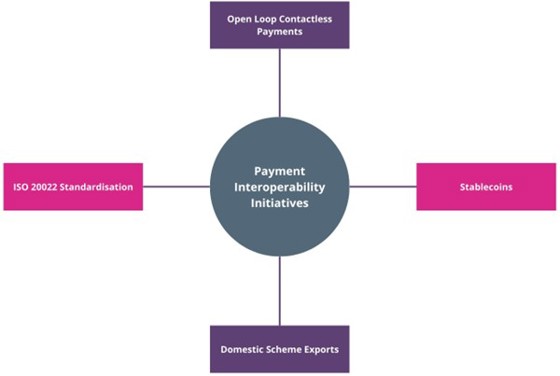
Source: Juniper Research
Open Loop Contactless Payments
Contactless payments have seen strong growth in most developed markets, with our latest report in this area finding that the value of contactless payment transactions will grow by 113% over the next five years, from $7.4 trillion in 2024.
Contactless payments are replacing closed loop solutions with open loop ones, particularly in the realm of consumer payments – for example, the shift from closed loop gift cards to open loop prepaid cards, and the introduction of contactless payment acceptance at electric vehicle chargers; replacing app-specific payment systems. However, it must be noted that while these do represent more open loop systems, they are still reliant on cards, with acceptance not being universal for different brands across geographies. As such, while the general shift is promising, there is still work to do.
ISO 20022 Standardisation
Many payment systems have already been, or are in the process of being updated to offer real-time functionality; for instance, UPI in India and Pix in Brazil.
As part of this process, real-time payment systems are typically based on the international ISO 20022 standard, which standardises the way in which systems work. This means that in principle at least, real-time payments should be relatively straightforward to harmonise across borders. This is already ongoing in places, with Project Nexus aiming to connect several schemes in Asia. However, while ISO 20022 simplifies standardisation, this is not the default, and it requires bilateral and multilateral agreements to obtain full interoperability.
Stablecoins
Stablecoins have been increasingly high profile within the payments ecosystem. By using cryptocurrency technology but pegging values to fiat currencies, stablecoins provide the best of both worlds – they are digitally native, but also lack the volatility of cryptocurrency. This has seen stablecoins become an important channel, with brands such as PayPal developing their own stablecoins. Stablecoins ignore borders in the traditional sense, but are still linked to specific currencies. Therefore, while stablecoins are technically interoperable, or at least can be used across borders seamlessly, there are still challenges in using these in certain markets, as well as there being uncertain regulations.
Domestic Scheme Exports
A popular trend we have seen in the export of domestic instant payment schemes. For example, NPCI International Payments has been highly active in exporting the technology underpinning UPI in India, with UPI-based solutions being under development in Trinidad & Tobago, Peru and Qatar. NPCI has also partnered with Google Pay to accelerate global expansion. Pix in Brazil is also making international moves, as are digital wallets such as Alipay, with Alipay+.
However, these schemes are also fragmented, so while boosting interoperability in certain cases, it will take a lot of time to standardise payments in this way.
Major Challenges
While great strides are being made towards interoperability, these initiatives all have their limitations. There are also some major challenges to interoperability:
- CBDCs: CBDCs are a form of central bank-issued digital currency, which many countries are in the process of exploring and piloting. CBDCs are digitally native, and are intended in many cases to replace cards; moving payment sovereignty back to individual governments. However, this has the effect of migrating traffic from an open loop system back to a closed loop one.
- Missing A2A Interoperability: A2A payments are growing in popularity, with our latest forecasts predicting that A2A payment transactions will rise from 60 billion in 2024 to 186 billion by 2029; an increase of 209%. However, while these schemes are rising in popularity, they are not by default interoperable, with this needing to be added in a multilateral or bilateral way. As such, this will likely remain highly fragmented for the foreseeable future.
- Closed-loop Digital Wallets: Digital wallets are increasingly becoming the default choice for consumer payments, with apps such as Apple Pay, Google Pay, Alipay and WeChat Pay being increasingly popular. While these are more convenient, digital wallets are typically not interoperable – balances typically cannot be transferred between different wallet brands, and payment buttons are linked to specific wallets on eCommerce checkouts. While interoperability is a requirement in certain emerging markets, it is still uncommon in developed markets. As such, wallets are not generally improving interoperability.
What Path is the Payments Industry On?
As we have seen, interoperability is a mixed picture. However, we believe that the general trend is towards increasing openness. This is primarily because fragmentation is harming payments – cross-border in particular is a challenge for both consumers and businesses. We expect that interoperability will become a key part of payment system design and regulatory requirements. However, some fragmentation is inevitable – a fully interoperable future is still a distant prospect.
Nick Maynard is Juniper Research's VP of Fintech Market Research, and enjoys helping clients to size new market opportunities, set priorities for future growth, and understand their customers through survey projects. He has been interviewed by major news outlets such as CNBC, Coindesk, and the BBC, and has spoken at key industry events including Money 20/20 Europe.
Related Research
-
 ReportAugust 2026Contactless Payments
 Nick MaynardContactless Payments Market Data, 2026-2031
Our Contactless Payments market analysis provides exhaustive data coverage of the market in its entirety, including the adoption of mobile wallets featuring contactless payment technology, the growth of contactless transactions, and the market’s associated values.
VIEW -
 ReportSeptember 2025Fintech & Payments
 Thomas WilsonA2A Payments Market, 2025-2030
Our A2A Payments research suite provides detailed analysis of this rapidly changing market; enabling A2A payments service providers to gain an understanding of key payment trends and challenges, potential growth opportunities, and the competitive environment.
VIEW -
 ReportNovember 2025Digital Wallets
Thomas WilsonDigital Wallets Market, 2025-2030
ReportNovember 2025Digital Wallets
Thomas WilsonDigital Wallets Market, 2025-2030Our digital wallets research suite provides detailed analysis of this rapidly changing market; allowing digital wallet providers to gain an understanding of key payment trends and challenges, potential growth opportunities, and the competitive environment.
VIEW
Latest research, whitepapers & press releases
-
 ReportOctober 2026Fintech & Payments
 Jawad JahanCrypto-gaming Market: 2026-2035
Our Crypto-gaming Market research suite provides an insightful analysis of this rapidly growing market; enabling stakeholders - from crypto-gaming and sportsbooks operators, prediction market platforms, business-to-business (B2B) gambling platforms and software providers, to crypto payment processors and regulators - to understand future growth, key trends, and the competitive environment.
VIEW -
 ReportOctober 2026Telecoms & Connectivity
 Alex WebbRetail Roaming Market: 2026-2031
Our Retail Roaming research suite for mobile network operators (MNOs) and mobile virtual network operators (MVNOs) provides detailed analysis and strategic recommendations for the next era of retail roaming.
VIEW -
 ReportSeptember 2026Fintech & Payments
 Dr Manju ChhillarEmbedded Finance Market: 2026-2031
Embedded finance is one of the fastest-growing markets in financial services, and is about to accelerate even further. Our Embedded Finance Market research provides detailed analysis of the key drivers behind this growth, and what these mean for stakeholders in this market.
VIEW -
 ReportSeptember 2026Identity & Security
 Thomas WilsonApplication Security Market: 2026-2031
Our Application Security research suite provides detailed analysis of this emerging market; allowing application security providers to gain an understanding of key security trends and challenges, potential growth opportunities, and the competitive environment.
VIEW -
 ReportSeptember 2026Fintech & Payments
 Shane O'SullivanBanking Fraud Prevention Market: 2026-2031
Our Banking Fraud Prevention research suite provides a comprehensive and in-depth analysis of the types of fraud currently impacting the banking sector, and the evolving methods that can be used to overcome them.
VIEW -
 ReportSeptember 2026Telecoms & Connectivity
 Nick MaynardPrivate LTE & 5G Networks Market: 2026-2031
Our Private LTE & 5G Networks research suite provides detailed and insightful analysis of this evolving market; enabling stakeholders - from private LTE & 5G network platform specialists, mobile network operators, and diversified technology companies - to understand future growth, key trends, and the competitive environment.
VIEW


-
 WhitepaperOctober 2026Fintech & Payments
Jawad Jahan
WhitepaperOctober 2026Fintech & Payments
Jawad JahanCompliance or Anonymity - The Crypto-gaming Operator’s Dilemma
Our complimentary whitepaper, Compliance or Anonymity - The Crypto-gaming Operator’s Dilemma, analyses the current regulatory landscape of the crypto-gaming market.
VIEW -
 WhitepaperOctober 2026Telecoms & Connectivity
Alex Webb
WhitepaperOctober 2026Telecoms & Connectivity
Alex WebbReimagining the Future of Retail Roaming – How Mobile Network Operators Must Adapt
Our complimentary whitepaper, Reimagining the Future of Retail Roaming – How Mobile Network Operators Must Adapt, explores the emerging opportunities for MNOs within retail roaming.
VIEW -
 WhitepaperSeptember 2026Fintech & Payments
Dr Manju Chhillar
WhitepaperSeptember 2026Fintech & Payments
Dr Manju ChhillarEmerging Markets: The Next Opportunity for Embedded Finance
This free whitepaper examines how a combination of multiple factors is driving North America towards saturation for embedded finance.
VIEW -
 WhitepaperSeptember 2026Emerging Technology
Thomas Wilson
WhitepaperSeptember 2026Emerging Technology
Thomas WilsonVibe Coding: The Fastest-growing Threat to Application Security Today
Our complimentary whitepaper, Vibe Coding: The Fastest-growing Threat to Application Security Today, examines the state of the application security market; considering its impact on different verticals, and how it is being employed in these verticals to best combat malicious attackers and keep sensitive data safe.
VIEW -
 WhitepaperSeptember 2026Fintech & Payments
Shane O'Sullivan
WhitepaperSeptember 2026Fintech & Payments
Shane O'SullivanThe Fraud Frontier: Securing Banking in an AI-driven Era
Our complimentary whitepaper, The Fraud Frontier: Securing Banking in an AI-driven Era, examines the rapidly evolving state of the banking fraud prevention market.
VIEW -
 WhitepaperSeptember 2026Telecoms & Connectivity
Nick Maynard
WhitepaperSeptember 2026Telecoms & Connectivity
Nick MaynardHow Private Cellular Networks Are Unlocking Industry 4.0
Our complimentary whitepaper, How Private Cellular Networks Are Unlocking Industry 4.0, examines how private LTE & 5G networks are reshaping the way industry works.
VIEW


-
Fintech & Payments
Crypto Gaming: Wagers to Reach $1.3 Trillion by 2035, as Crypto Rails Widen Global Access Despite Regulatory Challenges
October 2026 -
Fintech & Payments
Juniper Research Unveils Identity & Security Award Winners for 2026
October 2026 -
Retail Roaming Revenue to Fall $4 Billion By 2031, as Regulatory Restrictions and Competition Bite
October 2026 -
Fintech & Payments
Soft POS to Surpass 100 Million Installations in 2030
September 2026 -
Fintech & Payments
The NextGen Payments & RegTech Forum Arrives in Dubai
September 2026 -
Fintech & Payments
The Global Trade Finance Expo Arrives in Dubai, UAE
September 2026