Is the UK Finally Warming Up to Heat Pumps?

Heat pumps are an energy-efficient technology which operates by moving heat energy from one place to another via a refrigeration cycle. When in ‘heating’ mode, a heat pump extracts heat energy from the outside environment and transfers it to indoor spaces. It is able to achieve this effectively, even in cold weather. When in ‘cooling’ mode, this process is reversed essentially; removing heat energy from inside the building and transferring it to the outdoors.
Heat pumps represent a central technology in the global transition to sustainable heating methods and decarbonisation. Typically three to five times more efficient than a traditional gas boiler system, heat pumps significantly reduce a property’s exposure to fossil fuel price spikes and greenhouse gas emissions in major heating markets. Furthermore, when coupled with a renewable energy solution such as a solar panel system, a home can become self sufficient in terms of heating and cooling itself.
The UK is one nation in particular which is lagging behind in terms of heat pump adoption in residential properties. This can currently be attributed to a lack of effective incentives and regulations that can help homeowners to offset the initial investment cost of purchasing a heat pump, as well as the strict regulations which homes must meet in order to have a heat pump retrofitted.
Households with Heat Pumps Installed (m), 2024-2029
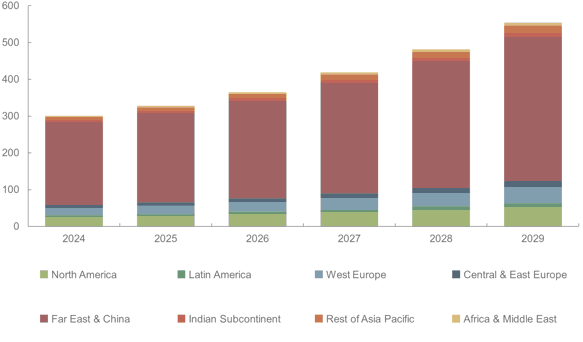
Source: Juniper Research
However, the Financial Times revealed at the end of 2024 that the new government could bring forward the ban on gas boilers in new build homes from 2035 to 2027; demonstrating a clear commitment to the decarbonisation of the UK. This is set to be included under the Future Homes Standard, which comes into effect in 2025, and includes other measures which are expected to increase the accessibility to heat pumps across the nation.
Future Homes Standard (FHS)
Starting in 2025, the FHS mandates that all new homes in England are to be equipped with some form of low-carbon heating system, including heat pumps. This initiative aims to ensure that new homes produce up to 80% less carbon emissions, compared to those built under previous regulations.
Under this, permitted development rights are set to be amended in order to allow for the installation of larger heat pumps without the need for specific planning permissions. As of January 2025, any air-source heat pump larger than 0.6m3 requires planning; ruling out twin fan units and those with lower sound levels which often include more noise deadening in their casing.
Additionally, the proposed change will allow homeowners with detached houses to have two heat pumps installed without the need for planning permission. Currently, all homeowners must seek permission for more than one unit. Furthermore, the government will eliminate the rule requiring heat pumps to be installed at least one metre away from a property's boundary. This adjustment aims to simplify the installation process; making it more accessible for households, especially in densely populated areas.
Boiler Upgrade Scheme (BUS)
The well-established BUS provides grants to support heat pump installations. The government has raised the grant amount to £7,500 and plans to almost double the scheme's budget to £295 million for the 2025/2026 financial year. This boost is intended to make heat pumps more accessible and appealing to homeowners by offsetting a portion of the upfront cost.
Clean Heat Market Mechanism (CHMM)
The CHMM, set to begin on April 1st 2025, will require boiler manufacturers to ensure that 6% of their sales consist of heat pumps during the 2025-2026 period. To ease this transition, the government has lowered the penalties for non-compliance from £5,000 to £500 per missed heat pump sale; giving manufacturers more time to build supply chains and promote heat pump adoption.
Initially planned for a 2024 launch, the CHMM faced significant opposition from boiler manufacturers, merchants, and installers; leading to its delay. It remains an ambitious policy, and the industry may not yet be fully ready for its implementation. However, if the ban on gas boilers is in fact brought forward to 2027, then heat pump manufacturers and installers may feel that the 6% goal is more realistic.
These planning reforms and financial incentives are key elements of the UK government’s strategy to advance low-carbon heating solutions and reach net-zero carbon emissions by 2050. By streamlining the installation process, reducing regulatory hurdles, and offering financial support, the government seeks to speed up the adoption of heat pumps throughout the UK.
As for the year ahead, the FHS and BUS both represent schemes that will most certainly increase the accessibility of heat pumps in the UK, by helping to offset a portion of the initial purchase price, and ensuring that new build homes are fitted with a heat pump system of some kind. There will be a large spike in the number of UK homes fitted with heat pumps, and as a result of this, installers and manufacturers will feel more comfortable with the CHMM and encouraging wider heat pump adoption.
Thomas is a Research Analyst within Juniper Research’s Sustainability & Smart Cities team; and provides up-to-date trends analysis, competitive landscape appraisal, and market sizing for industries such as Renewable Energy Technology and EV Charging & Batteries.
Latest research, whitepapers & press releases
-
 ReportOctober 2026Fintech & Payments
 Jawad JahanCrypto-gaming Market: 2026-2035
Our Crypto-gaming Market research suite provides an insightful analysis of this rapidly growing market; enabling stakeholders - from crypto-gaming and sportsbooks operators, prediction market platforms, business-to-business (B2B) gambling platforms and software providers, to crypto payment processors and regulators - to understand future growth, key trends, and the competitive environment.
VIEW -
 ReportOctober 2026Telecoms & Connectivity
 Alex WebbRetail Roaming Market: 2026-2031
Our Retail Roaming research suite for mobile network operators (MNOs) and mobile virtual network operators (MVNOs) provides detailed analysis and strategic recommendations for the next era of retail roaming.
VIEW -
 ReportSeptember 2026Fintech & Payments
 Dr Manju ChhillarEmbedded Finance Market: 2026-2031
Embedded finance is one of the fastest-growing markets in financial services, and is about to accelerate even further. Our Embedded Finance Market research provides detailed analysis of the key drivers behind this growth, and what these mean for stakeholders in this market.
VIEW -
 ReportSeptember 2026Identity & Security
 Thomas WilsonApplication Security Market: 2026-2031
Our Application Security research suite provides detailed analysis of this emerging market; allowing application security providers to gain an understanding of key security trends and challenges, potential growth opportunities, and the competitive environment.
VIEW -
 ReportSeptember 2026Fintech & Payments
 Shane O'SullivanBanking Fraud Prevention Market: 2026-2031
Our Banking Fraud Prevention research suite provides a comprehensive and in-depth analysis of the types of fraud currently impacting the banking sector, and the evolving methods that can be used to overcome them.
VIEW -
 ReportSeptember 2026Telecoms & Connectivity
 Nick MaynardPrivate LTE & 5G Networks Market: 2026-2031
Our Private LTE & 5G Networks research suite provides detailed and insightful analysis of this evolving market; enabling stakeholders - from private LTE & 5G network platform specialists, mobile network operators, and diversified technology companies - to understand future growth, key trends, and the competitive environment.
VIEW


-
 WhitepaperOctober 2026Fintech & Payments
Jawad Jahan
WhitepaperOctober 2026Fintech & Payments
Jawad JahanCompliance or Anonymity - The Crypto-gaming Operator’s Dilemma
Our complimentary whitepaper, Compliance or Anonymity - The Crypto-gaming Operator’s Dilemma, analyses the current regulatory landscape of the crypto-gaming market.
VIEW -
 WhitepaperOctober 2026Telecoms & Connectivity
Alex Webb
WhitepaperOctober 2026Telecoms & Connectivity
Alex WebbReimagining the Future of Retail Roaming – How Mobile Network Operators Must Adapt
Our complimentary whitepaper, Reimagining the Future of Retail Roaming – How Mobile Network Operators Must Adapt, explores the emerging opportunities for MNOs within retail roaming.
VIEW -
 WhitepaperSeptember 2026Fintech & Payments
Dr Manju Chhillar
WhitepaperSeptember 2026Fintech & Payments
Dr Manju ChhillarEmerging Markets: The Next Opportunity for Embedded Finance
This free whitepaper examines how a combination of multiple factors is driving North America towards saturation for embedded finance.
VIEW -
 WhitepaperSeptember 2026Emerging Technology
Thomas Wilson
WhitepaperSeptember 2026Emerging Technology
Thomas WilsonVibe Coding: The Fastest-growing Threat to Application Security Today
Our complimentary whitepaper, Vibe Coding: The Fastest-growing Threat to Application Security Today, examines the state of the application security market; considering its impact on different verticals, and how it is being employed in these verticals to best combat malicious attackers and keep sensitive data safe.
VIEW -
 WhitepaperSeptember 2026Fintech & Payments
Shane O'Sullivan
WhitepaperSeptember 2026Fintech & Payments
Shane O'SullivanThe Fraud Frontier: Securing Banking in an AI-driven Era
Our complimentary whitepaper, The Fraud Frontier: Securing Banking in an AI-driven Era, examines the rapidly evolving state of the banking fraud prevention market.
VIEW -
 WhitepaperSeptember 2026Telecoms & Connectivity
Nick Maynard
WhitepaperSeptember 2026Telecoms & Connectivity
Nick MaynardHow Private Cellular Networks Are Unlocking Industry 4.0
Our complimentary whitepaper, How Private Cellular Networks Are Unlocking Industry 4.0, examines how private LTE & 5G networks are reshaping the way industry works.
VIEW


-
Fintech & Payments
The 25th NextGen Payments & RegTech Forum Arrives in Athens, Greece
October 2026 -
Fintech & Payments
Crypto Gaming: Wagers to Reach $1.3 Trillion by 2035, as Crypto Rails Widen Global Access Despite Regulatory Challenges
October 2026 -
Fintech & Payments
Juniper Research Unveils Identity & Security Award Winners for 2026
October 2026 -
Retail Roaming Revenue to Fall $4 Billion By 2031, as Regulatory Restrictions and Competition Bite
October 2026 -
Fintech & Payments
Soft POS to Surpass 100 Million Installations in 2030
September 2026 -
Fintech & Payments
The NextGen Payments & RegTech Forum Arrives in Dubai
September 2026