Interbank Tokenised Deposits Debut in the UK

On September 27th 2026, the first live customer transactions were completed by British banks using tokenised deposits. Tokenised deposits are a digital representation of an existing fiat balance held at a licensed bank; recorded on a distributed ledger. The underlying deposit remains on the bank’s balance sheet, and is therefore covered by existing regulatory protection. The platform used to conduct the transactions is built by Quant, a technology infrastructure platform.
The transactions were made through the Great British Tokenised Deposit Initiative, which is convened by UK Finance and includes seven major high street banks: Barclays, Nationwide, NatWest, Santander, Monzo, Lloyds Banking Group, and HSBC UK. This represents the first instance of tokenised deposits being issued across different institutions, rather than being inside the same lender’s systems.
The Transactions: Improving Mortgage Payments and the Marketplace
Currently, the area of remortgages and deposits is one that is plagued with considerable friction in the UK. As high-value transactions, they often take a few business days to clear, and may be subject to manual checks and delayed further.
Source: Juniper Research
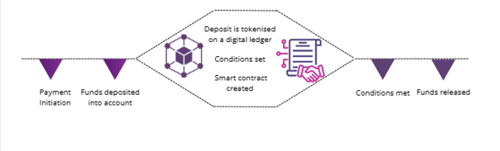
The use cases demonstrated by the test revolved around mortgages. Two remortgage completions were carried out, where the deposit funds were locked until their release at completion of the required checks. This reduces the manual processes required to complete the property transaction, and reduces transaction time. Another potential benefit is that the blockchain is an immutable ledger that can record title deeds and history of ownership. Furthermore, borrowers can keep earning interest on the money until the deal is closed.
The tokenised deposits were used to lock funds in until completion, and once conditions were met, they were released automatically. This is possible because of the programmability capabilities inherent within blockchain technology. Programmable payments use smart contracts to automate money transfers based on predefined rules, which are coded to self-execute once the conditions have been met.
Further Use Cases: The Marketplace
The other transaction completed in the UK was in regard to the marketplace. A consumer marketplace transaction involved funds locked into the buyer account, which are only released upon the condition of confirmation that the goods have been received.
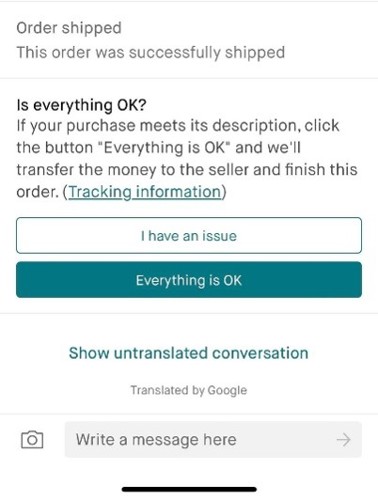
However, there is the question of how effective these payment innovations are when existing marketplaces already have this capability. For example, the second-hand clothes marketplace Vinted takes the funds from the buyer when they purchase the item, holds the funds in a third-party account, and releases it when the courier confirms package delivery, and the buyer confirms that the item is as described. In terms of user experience, this is not functionally different from what they would experience if a smart contract was used, and the payment logic was embedded directly within the commercial bank money. The return on investing in a new payments mechanism to end up with effectively the same result is low.
 Source: Vinted
Instead of consumer marketplaces, tokenised deposits may become more prevalent within the B2B supply chain. In these scenarios, the considerable amounts of liquidity locked up in supply payments is high; making gains in the speed of settlement valuable. As tokenised settlement makes atomic swaps possible, the counterparty risk on high-value transactions is reduced.
Tokenised Deposits Around the World
This initiative in the UK joins similar ones found worldwide. For example, six major banks in Canada are exploring the same model at an interbank level, while US banks are developing tokenised deposit networks. Separately, SWIFT is testing infrastructure designed to connect banks and provide ledgers for tokenised deposits that are available to settle payments in real-time. This became operational on the 9th July 2026, when their blockchain-based ledger became available for 17 banks over six continents to pilot live transactions.
Related Research
-
 ReportSeptember 2026Fintech & Payments
 Dr Manju ChhillarEmbedded Finance Market, 2026-2031
Embedded finance is one of the fastest-growing markets in financial services, and is about to accelerate even further. Our Embedded Finance Market research provides detailed analysis of the key drivers behind this growth, and what these mean for stakeholders in this market.
VIEW -
 ReportJuly 2026Fintech & Payments
 Thomas WilsonNetwork Tokenisation Market, 2026-2031
Our Network Tokenisation research suite provides a comprehensive and in-depth analysis of the ecosystem surrounding network tokenisation, enabling stakeholders such as merchants, payment gateways, token service providers and token requestors to understand future growth, key trends and the competitive environment.
VIEW -
 ReportSeptember 2026Fintech & Payments
 Michael GreenwoodOmnichannel Payment Platform Market, 2026-2031
Our Omnichannel Payment Platform research provides detailed analysis of this rapidly emerging market; allowing omnichannel payment platform providers to gain an understanding of key payment trends and challenges, potential growth opportunities, and the competitive environment.
VIEW
Latest research, whitepapers & press releases
-
 ReportOctober 2026Fintech & Payments
 Jawad JahanCrypto-gaming Market: 2026-2035
Our Crypto-gaming Market research suite provides an insightful analysis of this rapidly growing market; enabling stakeholders - from crypto-gaming and sportsbooks operators, prediction market platforms, business-to-business (B2B) gambling platforms and software providers, to crypto payment processors and regulators - to understand future growth, key trends, and the competitive environment.
VIEW -
 ReportOctober 2026Telecoms & Connectivity
 Alex WebbRetail Roaming Market: 2026-2031
Our Retail Roaming research suite for mobile network operators (MNOs) and mobile virtual network operators (MVNOs) provides detailed analysis and strategic recommendations for the next era of retail roaming.
VIEW -
 ReportSeptember 2026Fintech & Payments
 Dr Manju ChhillarEmbedded Finance Market: 2026-2031
Embedded finance is one of the fastest-growing markets in financial services, and is about to accelerate even further. Our Embedded Finance Market research provides detailed analysis of the key drivers behind this growth, and what these mean for stakeholders in this market.
VIEW -
 ReportSeptember 2026IoT & Emerging Technology
 Thomas WilsonApplication Security Market: 2026-2031
Our Application Security research suite provides detailed analysis of this emerging market; allowing application security providers to gain an understanding of key security trends and challenges, potential growth opportunities, and the competitive environment.
VIEW -
 ReportSeptember 2026Fintech & Payments
 Shane O'SullivanBanking Fraud Prevention Market: 2026-2031
Our Banking Fraud Prevention research suite provides a comprehensive and in-depth analysis of the types of fraud currently impacting the banking sector, and the evolving methods that can be used to overcome them.
VIEW -
 ReportSeptember 2026Telecoms & Connectivity
 Nick MaynardPrivate LTE & 5G Networks Market: 2026-2031
Our Private LTE & 5G Networks research suite provides detailed and insightful analysis of this evolving market; enabling stakeholders - from private LTE & 5G network platform specialists, mobile network operators, and diversified technology companies - to understand future growth, key trends, and the competitive environment.
VIEW


-
 WhitepaperOctober 2026Telecoms & Connectivity
Alex Webb
WhitepaperOctober 2026Telecoms & Connectivity
Alex WebbReimagining the Future of Retail Roaming – How Mobile Network Operators Must Adapt
Our complimentary whitepaper, Reimagining the Future of Retail Roaming – How Mobile Network Operators Must Adapt, explores the emerging opportunities for MNOs within retail roaming.
VIEW -
 WhitepaperSeptember 2026Fintech & Payments
Dr Manju Chhillar
WhitepaperSeptember 2026Fintech & Payments
Dr Manju ChhillarEmerging Markets: The Next Opportunity for Embedded Finance
This free whitepaper examines how a combination of multiple factors is driving North America towards saturation for embedded finance.
VIEW -
 WhitepaperSeptember 2026IoT & Emerging Technology
Thomas Wilson
WhitepaperSeptember 2026IoT & Emerging Technology
Thomas WilsonVibe Coding: The Fastest-growing Threat to Application Security Today
Our complimentary whitepaper, Vibe Coding: The Fastest-growing Threat to Application Security Today, examines the state of the application security market; considering its impact on different verticals, and how it is being employed in these verticals to best combat malicious attackers and keep sensitive data safe.
VIEW -
 WhitepaperSeptember 2026Fintech & Payments
Shane O'Sullivan
WhitepaperSeptember 2026Fintech & Payments
Shane O'SullivanThe Fraud Frontier: Securing Banking in an AI-driven Era
Our complimentary whitepaper, The Fraud Frontier: Securing Banking in an AI-driven Era, examines the rapidly evolving state of the banking fraud prevention market.
VIEW -
 WhitepaperSeptember 2026Telecoms & Connectivity
Nick Maynard
WhitepaperSeptember 2026Telecoms & Connectivity
Nick MaynardHow Private Cellular Networks Are Unlocking Industry 4.0
Our complimentary whitepaper, How Private Cellular Networks Are Unlocking Industry 4.0, examines how private LTE & 5G networks are reshaping the way industry works.
VIEW -
 WhitepaperSeptember 2026Fintech & Payments
 Michael Greenwood
How Omnichannel Payment Platforms Are Streamlining Merchant Operations
Our complimentary whitepaper, How Omnichannel Payment Platforms Are Streamlining Merchant Operations, examines how merchants are utilising omnichannel payment platforms to capitalise on customer data and integration with other business management software in order to minimise inefficiency.
VIEW


-
Retail Roaming Revenue to Fall $4 Billion By 2031, as Regulatory Restrictions and Competition Bite
October 2026 -
Fintech & Payments
Soft POS to Surpass 100 Million Installations in 2030
September 2026 -
Fintech & Payments
The NextGen Payments & RegTech Forum Arrives in Dubai
September 2026 -
Fintech & Payments
The Global Trade Finance Expo Arrives in Dubai, UAE
September 2026 -
Fintech & Payments
The Vision Forex Forum Arrives in Dubai, UAE
September 2026 -
Fintech & Payments
Embedded Finance Revenue to Reach $617 Billion Globally by 2031, as B2B Revenue Surges 390%
September 2026