Green Fintech 365: Inside the Sustainable Future

The emergence of fintech companies offering innovative climate solutions is gaining traction, thanks to increased interest from investors and driven by the introduction of regulations aimed at holding corporations accountable for the environmental consequences of their operations.
Green fintech is a broad area, which can be defined as:
“Technology that helps provide sustainable solutions to financial services, through payments, monitoring, risk, and reporting technologies."
Sometimes referred to as climate fintechs, a large proportion of green fintechs are still in their early venture funding stage, otherwise known as the growth stage. We anticipate these companies to continue to boom over the coming year. Below is an outline of the key areas within green fintech.
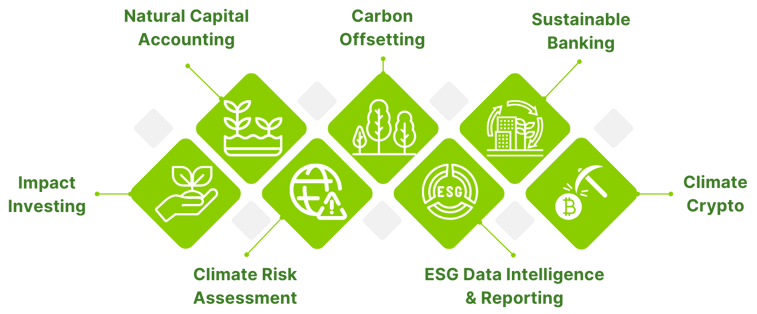
Source: Juniper Research
- Natural Capital Accounting: Sometimes called Carbon Accounting, this quantifies the value of nature. It measures the amount and condition of natural resources such as forests; this information is then used by governments and businesses under the globally standardised framework SEEA (System of Environmental-Economic Accounting).
- Climate Risk Assessment: Using data and climate models, climate risk management helps organisations prepare for climate change impacts and assists with reduced emission planning and regulatory reporting.
- Carbon Offsetting: Carbon tracking and offsetting companies help organisations to measure, reduce, and compensate for their carbon emissions. They offer services such as carbon footprint analysis, reduction strategies, and investment into carbon offsetting projects.
- ESG Data Intelligence & Reporting: ESG reporting is all about disclosing information about an organisation’s operations and risks in three areas: environmental stewardship, social responsibility, and corporate governance.
- Sustainable Banking: A more modern approach to banking, in which banks attempt to lessen their environmental impact by considering the environmental and social impacts of their decisions.
- Climate Crypto: Otherwise known as ‘Crypto for Climate’, companies leverage cryptocurrency and blockchain to address climate challenges. This includes carbon offsetting and tokenisation, green energy for crypto mining, and climate investments.
- Impact Investing: Impact-focused investing, or simply impact investing, is an investment strategy that seeks to achieve social or environmental goals, as well as generate profit.
What’s Driving the Green Fintech Market?
- Increased Demand for Sustainable Solutions: There is a growing demand from consumers and businesses for more sustainable financial products and services, driven by more sustainability-conscious consumers wanting to measure and lower their carbon footprint through responsible shopping, banking, and investment.
- Regulatory Drivers: New regulations are pushing financial companies to report climate-related risks, creating a need for tools to meet these requirements. Climate-related policies, like the European Green Deal and SFDR (Sustainable Finance Disclosures Regulation), are forcing companies to disclose their environmental impacts and focus on lowering carbon emissions.
- Technological Advancements: Climate fintech is a broad area which utilises a wide range of next-generation technologies that are unlocking new capabilities; for example, the use of blockchain for carbon offset trading and verification. Another example is how APIs and embedded finance are enabling climate-focused financial products.
- Investment Trends: Despite an overall decline in venture capital funding, climate fintechs are attracting significant investment. In fact, climate-focused fintech startups are raising more funding than other fintech startups. Later-stage deals are becoming more common as the sector matures. Europe is leading in climate fintech funding, with European startups raising $1.4 billion compared to $881 million in the US, according to a report by CommerzVentures.
What are the Biggest Challenges in the Green Fintech Market?
There are several challenges green fintechs will have to overcome, in order to remain competitive in this pivotal stage of the market’s development.
- Data Challenges: The green fintech market struggles with data quality and availability, as there is often is a lack of comprehensive, high-quality climate-related data, especially for certain asset classes like private markets. This means it can be challenging for companies to accurately assess climate risks and opportunities. Standarisation is another issue, with the absence of uniform reporting standards making it challenging to compare sustainability performance across different companies and sectors. As such, financial institutions often struggle to integrate climate data from multiple vendors into their existing systems and technology stacks.
- Technological Hurdles: Developing solutions that can effectively address climate challenges at a global scale remains a significant issue. For example, many climate fintech solutions rely on energy-intensive technologies like blockchain, AI, and cloud computing, which can conflict with businesses’ sustainability goals.
- Methodological Limitations: There is no standardised approach for measuring and reporting carbon impacts across product lifecycles. Climate models are highly complex, and accurately assessing and pricing climate risks requires sophisticated modelling capabilities that many companies are still developing.
What Does the Future Hold for the Green Fintech Market?
Positioned at the forefront of financial and climate technological innovation, the green fintech market is set to experience rapid development. However, we anticipate significant market and business challenges; the climate fintech space is crowded by many startups, with a fragmented market leading to potential consolidation and fierce competition.
In order to prove their effectiveness, Juniper Research believes that green fintech companies must demonstrate that their solutions have a real, measurable impact on climate change mitigation and overall environmental goals. This will help establish their long-term viability, profitability and longevity, something many startups in emerging fields find challenging.
Daniel analyses developments in financial and payments markets, and how these interplay with emerging technologies. His recent reports include Core Banking Systems, Anti-money Laundering Systems, and Banking-as-a-Service.
Latest research, whitepapers & press releases
-
 ReportOctober 2026Fintech & Payments
 Jawad JahanCrypto-gaming Market: 2026-2035
Our Crypto-gaming Market research suite provides an insightful analysis of this rapidly growing market; enabling stakeholders - from crypto-gaming and sportsbooks operators, prediction market platforms, business-to-business (B2B) gambling platforms and software providers, to crypto payment processors and regulators - to understand future growth, key trends, and the competitive environment.
VIEW -
 ReportOctober 2026Telecoms & Connectivity
 Alex WebbRetail Roaming Market: 2026-2031
Our Retail Roaming research suite for mobile network operators (MNOs) and mobile virtual network operators (MVNOs) provides detailed analysis and strategic recommendations for the next era of retail roaming.
VIEW -
 ReportSeptember 2026Fintech & Payments
 Dr Manju ChhillarEmbedded Finance Market: 2026-2031
Embedded finance is one of the fastest-growing markets in financial services, and is about to accelerate even further. Our Embedded Finance Market research provides detailed analysis of the key drivers behind this growth, and what these mean for stakeholders in this market.
VIEW -
 ReportSeptember 2026Identity & Security
 Thomas WilsonApplication Security Market: 2026-2031
Our Application Security research suite provides detailed analysis of this emerging market; allowing application security providers to gain an understanding of key security trends and challenges, potential growth opportunities, and the competitive environment.
VIEW -
 ReportSeptember 2026Fintech & Payments
 Shane O'SullivanBanking Fraud Prevention Market: 2026-2031
Our Banking Fraud Prevention research suite provides a comprehensive and in-depth analysis of the types of fraud currently impacting the banking sector, and the evolving methods that can be used to overcome them.
VIEW -
 ReportSeptember 2026Telecoms & Connectivity
 Nick MaynardPrivate LTE & 5G Networks Market: 2026-2031
Our Private LTE & 5G Networks research suite provides detailed and insightful analysis of this evolving market; enabling stakeholders - from private LTE & 5G network platform specialists, mobile network operators, and diversified technology companies - to understand future growth, key trends, and the competitive environment.
VIEW


-
 WhitepaperOctober 2026Fintech & Payments
Jawad Jahan
WhitepaperOctober 2026Fintech & Payments
Jawad JahanCompliance or Anonymity - The Crypto-gaming Operator’s Dilemma
Our complimentary whitepaper, Compliance or Anonymity - The Crypto-gaming Operator’s Dilemma, analyses the current regulatory landscape of the crypto-gaming market.
VIEW -
 WhitepaperOctober 2026Telecoms & Connectivity
Alex Webb
WhitepaperOctober 2026Telecoms & Connectivity
Alex WebbReimagining the Future of Retail Roaming – How Mobile Network Operators Must Adapt
Our complimentary whitepaper, Reimagining the Future of Retail Roaming – How Mobile Network Operators Must Adapt, explores the emerging opportunities for MNOs within retail roaming.
VIEW -
 WhitepaperSeptember 2026Fintech & Payments
Dr Manju Chhillar
WhitepaperSeptember 2026Fintech & Payments
Dr Manju ChhillarEmerging Markets: The Next Opportunity for Embedded Finance
This free whitepaper examines how a combination of multiple factors is driving North America towards saturation for embedded finance.
VIEW -
 WhitepaperSeptember 2026Emerging Technology
Thomas Wilson
WhitepaperSeptember 2026Emerging Technology
Thomas WilsonVibe Coding: The Fastest-growing Threat to Application Security Today
Our complimentary whitepaper, Vibe Coding: The Fastest-growing Threat to Application Security Today, examines the state of the application security market; considering its impact on different verticals, and how it is being employed in these verticals to best combat malicious attackers and keep sensitive data safe.
VIEW -
 WhitepaperSeptember 2026Fintech & Payments
Shane O'Sullivan
WhitepaperSeptember 2026Fintech & Payments
Shane O'SullivanThe Fraud Frontier: Securing Banking in an AI-driven Era
Our complimentary whitepaper, The Fraud Frontier: Securing Banking in an AI-driven Era, examines the rapidly evolving state of the banking fraud prevention market.
VIEW -
 WhitepaperSeptember 2026Telecoms & Connectivity
Nick Maynard
WhitepaperSeptember 2026Telecoms & Connectivity
Nick MaynardHow Private Cellular Networks Are Unlocking Industry 4.0
Our complimentary whitepaper, How Private Cellular Networks Are Unlocking Industry 4.0, examines how private LTE & 5G networks are reshaping the way industry works.
VIEW


-
Fintech & Payments
Crypto Gaming: Wagers to Reach $1.3 Trillion by 2035, as Crypto Rails Widen Global Access Despite Regulatory Challenges
October 2026 -
Fintech & Payments
Juniper Research Unveils Identity & Security Award Winners for 2026
October 2026 -
Retail Roaming Revenue to Fall $4 Billion By 2031, as Regulatory Restrictions and Competition Bite
October 2026 -
Fintech & Payments
Soft POS to Surpass 100 Million Installations in 2030
September 2026 -
Fintech & Payments
The NextGen Payments & RegTech Forum Arrives in Dubai
September 2026 -
Fintech & Payments
The Global Trade Finance Expo Arrives in Dubai, UAE
September 2026