Examining DTCC’s Upcoming Commercial Launch of Tokenisation Services

In October 2026, the Depository Trust & Clearing Corporation (DTCC) is expected to launch the ‘DTCC Tokenization Service’; allowing participants that hold securities at the Depository Trust Company (DTC) to readily convert their securities into tokens. But, before this article delves into the specifics, and what this means for market participants, we must first understand what the DTCC is.
The DTCC and its Subsidiaries
The DTCC is the backbone of US capital markets. It is a holding company owned by the financial institutions that use its services, and operates through three registered clearing agencies:
- The DTC: the central securities depository, which means it acts as the central vault and bookkeeper for US securities
- The National Securities Clearing Corporation (NSCC): the central counterparty for broker-to-broker trades in US equities, corporate bonds, and municipal bonds
- The Fixed Income Clearing Corporation (FICC): clears and settles US Treasury and agency mortgage-backed securities; trades through its Government Securities and Mortgage-Backed Securities Divisions
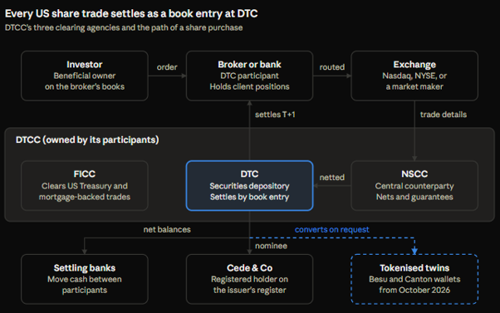
When an investor buys shares of a company through their broker, neither the investor nor the broker receives the share certificate. This is because almost all US stocks and bonds are held at the DTC, which maintains a ledger of which broker or bank owns how much. In turn, the broker or bank keeps its own ledger of which customers own what. Figure 1 illustrates DTCC and the role of its subsidiaries in settlements.
Figure 1: DTCC Settlement
Source: Juniper Research
DTCC commands enormous scale: in 2025, its subsidiaries (DTC, NSCC, FICC) processed transactions valued at $4.7 quadrillion, whilst DTC held $114 trillion of securities in custody, issued across more than 150 countries and territories.
The Anticipated Commercial Launch
Now, DTC wants to tokenise the assets it holds. In December 2025, the regulatory groundwork was laid down when the United States Securities and Exchange Commission’s (SEC’s) Division of Trading and Markets issued DTC a no-action letter permitting it to run a three-year pilot to tokenise DTC-custodied assets on supported blockchains. Furthermore, the relief extends to the participants of DTC; allowing them to tokenise securities on distributed ledgers, rather than only on DTC’s centralised ledger. The process is as follows:
- Participants opt in and register wallets on approved blockchains
- When prompted, DTC moves the security into a Digital Omnibus Account and mints tokens through its ComposerX Factory software
- DTC then delivers the tokens to the participant’s wallet
- From there, tokens can move directly between registered wallets without DTC instructing each transfer. Tokens can also be converted back to book-entry form at any time.
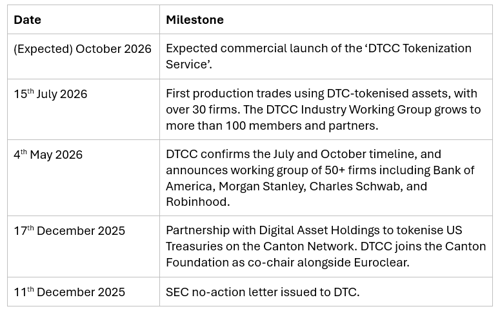
Since the no-action letter from the SEC in late 2025, DTCC has been moving forward with its pilot programme. Figure 2 shows the timeline of events that have occurred since the letter:
Figure 2: DTCC’s Tokenisation Timeline
Source: Juniper Research
The expected October 2026 launch should cover three core asset groups: constituents of the Russell 1000 Index, exchange-traded funds’ tracking major indices such as the S&P 500 and Nasdaq, and US Treasuries bills, notes and bonds. The selection covers some of the most liquid instruments DTC holds, reducing the risk of illiquid or fragmented token markets at launch.
Initially, tokens will be issued on two networks: LFDT Besu and Canton. Besu is an open-sourced Ethereum client maintained by the Linux Foundation Decentralized Trust (LFDT), which DTCC runs as a private, permissioned network. Canton is a public network built by Digital Asset for regulated finance, with privacy configured at the protocol level. Running both networks gives DTCC a controlled and shared environment from day one.
What it Means for Markets
Tokenised stocks are not new – but they lack functionality. Most of today’s offerings are issued by a third party, typically a special-purpose vehicle or regulated issuer, which buys the underlying shares, holds them 1:1 with a custodian, and issues tokens against them. Other implementations are structured simply as derivatives that track the share price. In both cases, the holder does not receive the full rights of share ownership, such as voting rights and shareholder protections. Similarly, the distribution of dividends passed through the underlying shares depends on the issuer’s solvency and custody arrangements.
DTC’s model changes this. The underlying shares never leave DTC, and remain registered in the name of its nominee. So, tokens would carry the same entitlements, investor protections, and ownership rights as traditional book-entry holders. Furthermore, token transfers between registered wallets can settle near-instantly, potentially improving capital efficiency in back-office functions.
The core benefit of keeping tokenisation with the DTC is that it enables growth without fragmenting the market. DTC remains the source of truth; ensuring the same security cannot circulate in traditional and digital markets at the same time, ie double spending. Similarly, it allows the DTC to enforce rules and control risks around tokenised stocks existing on digital markets, such as screening wallets against sanctions requirements from the Office of Foreign Assets Control (OFAC), and the ability to reverse erroneous or fraudulent transfers.
Once DTC-backed tokenised shares start trading and exchanging hands on approved blockchain, the tokens can be used within permissioned, approved applications that offer capabilities such as lending, borrowing, and liquidity provisioning for market making. The production trades conducted in July 2026 illustrated this range of use cases. For instance, in collateral and margin workflows, tokenised Treasuries or equities can be pledged to a counterparty and moved in minutes, including outside of market hours, as opposed to waiting on batch settlement cycles. This allows firms to meet intraday margin calls with assets they already hold, reducing the cash buffers they would otherwise need to keep on hand.
Looking Ahead
The DTCC is expected to commercially launch its tokenisation services in October 2026 – giving DTC participants the ability to tokenise securities held at the depository. The main aspect to watch will be the details accompanying the launch: DTC, subject to SEC’s no-action letter, must publish a list of its approved blockchains, tokenisation protocols, and any fees surrounding the service. This will indicate how open the service will be to existing networks and participants beyond the initial two chains.
Following this, the test will be in adoption. Measures such as volumes, the value of securities tokenised through DTC, number of registered wallets, and daily transfer activity etc will show whether market participants are moving assets on-chain, or not.
The no-action relief from the SEC lasts three years from launch, and the SEC staff can modify or revoke it at any time. This makes 2027 a decisive year, especially since it will be the first full year of production data, which will shape whether the service expands beyond its preliminary scope – assuming the DTCC goes ahead with the October 2026 launch. If adoption materialises, tokenisation within existing market infrastructure, such as DTC’s service, is likely to become the default route for institutional on-chain securities, leaving issuer-backed tokens to serve the markets DTC does not reach, such as non-US retail investors and crypto-native platforms.
Related Research
-
 ReportJuly 2026Fintech & Payments
 Thomas WilsonNetwork Tokenisation Market, 2026-2031
Our Network Tokenisation research suite provides a comprehensive and in-depth analysis of the ecosystem surrounding network tokenisation, enabling stakeholders such as merchants, payment gateways, token service providers and token requestors to understand future growth, key trends and the competitive environment.
VIEW -
 ReportSeptember 2026Fintech & Payments
 Shane O'SullivanBanking Fraud Prevention Market, 2026-2031
Our Banking Fraud Prevention research suite provides a comprehensive and in-depth analysis of the types of fraud currently impacting the banking sector, and the evolving methods that can be used to overcome them.
VIEW -
 ReportJuly 2026Fintech & Payments
 Jawad JahanPOS Market, 2026-2031
Our Point of Sale (POS) Market research suite provides detailed and insightful analysis of this evolving market; enabling stakeholders - from POS hardware manufacturers, payment infrastructure providers, software developers, and hospitality and retail vendors - to understand future growth, key trends, and the competitive environment.
VIEW
Latest research, whitepapers & press releases
-
 ReportOctober 2026Fintech & Payments
 Jawad JahanCrypto-gaming Market: 2026-2035
Our Crypto-gaming Market research suite provides an insightful analysis of this rapidly growing market; enabling stakeholders - from crypto-gaming and sportsbooks operators, prediction market platforms, business-to-business (B2B) gambling platforms and software providers, to crypto payment processors and regulators - to understand future growth, key trends, and the competitive environment.
VIEW -
 ReportOctober 2026Telecoms & Connectivity
 Alex WebbRetail Roaming Market: 2026-2031
Our Retail Roaming research suite for mobile network operators (MNOs) and mobile virtual network operators (MVNOs) provides detailed analysis and strategic recommendations for the next era of retail roaming.
VIEW -
 ReportSeptember 2026Fintech & Payments
 Dr Manju ChhillarEmbedded Finance Market: 2026-2031
Embedded finance is one of the fastest-growing markets in financial services, and is about to accelerate even further. Our Embedded Finance Market research provides detailed analysis of the key drivers behind this growth, and what these mean for stakeholders in this market.
VIEW -
 ReportSeptember 2026Identity & Security
 Thomas WilsonApplication Security Market: 2026-2031
Our Application Security research suite provides detailed analysis of this emerging market; allowing application security providers to gain an understanding of key security trends and challenges, potential growth opportunities, and the competitive environment.
VIEW -
 ReportSeptember 2026Fintech & Payments
 Shane O'SullivanBanking Fraud Prevention Market: 2026-2031
Our Banking Fraud Prevention research suite provides a comprehensive and in-depth analysis of the types of fraud currently impacting the banking sector, and the evolving methods that can be used to overcome them.
VIEW -
 ReportSeptember 2026Telecoms & Connectivity
 Nick MaynardPrivate LTE & 5G Networks Market: 2026-2031
Our Private LTE & 5G Networks research suite provides detailed and insightful analysis of this evolving market; enabling stakeholders - from private LTE & 5G network platform specialists, mobile network operators, and diversified technology companies - to understand future growth, key trends, and the competitive environment.
VIEW


-
 WhitepaperOctober 2026Fintech & Payments
Jawad Jahan
WhitepaperOctober 2026Fintech & Payments
Jawad JahanCompliance or Anonymity - The Crypto-gaming Operator’s Dilemma
Our complimentary whitepaper, Compliance or Anonymity - The Crypto-gaming Operator’s Dilemma, analyses the current regulatory landscape of the crypto-gaming market.
VIEW -
 WhitepaperOctober 2026Telecoms & Connectivity
Alex Webb
WhitepaperOctober 2026Telecoms & Connectivity
Alex WebbReimagining the Future of Retail Roaming – How Mobile Network Operators Must Adapt
Our complimentary whitepaper, Reimagining the Future of Retail Roaming – How Mobile Network Operators Must Adapt, explores the emerging opportunities for MNOs within retail roaming.
VIEW -
 WhitepaperSeptember 2026Fintech & Payments
Dr Manju Chhillar
WhitepaperSeptember 2026Fintech & Payments
Dr Manju ChhillarEmerging Markets: The Next Opportunity for Embedded Finance
This free whitepaper examines how a combination of multiple factors is driving North America towards saturation for embedded finance.
VIEW -
 WhitepaperSeptember 2026Emerging Technology
Thomas Wilson
WhitepaperSeptember 2026Emerging Technology
Thomas WilsonVibe Coding: The Fastest-growing Threat to Application Security Today
Our complimentary whitepaper, Vibe Coding: The Fastest-growing Threat to Application Security Today, examines the state of the application security market; considering its impact on different verticals, and how it is being employed in these verticals to best combat malicious attackers and keep sensitive data safe.
VIEW -
 WhitepaperSeptember 2026Fintech & Payments
Shane O'Sullivan
WhitepaperSeptember 2026Fintech & Payments
Shane O'SullivanThe Fraud Frontier: Securing Banking in an AI-driven Era
Our complimentary whitepaper, The Fraud Frontier: Securing Banking in an AI-driven Era, examines the rapidly evolving state of the banking fraud prevention market.
VIEW -
 WhitepaperSeptember 2026Telecoms & Connectivity
Nick Maynard
WhitepaperSeptember 2026Telecoms & Connectivity
Nick MaynardHow Private Cellular Networks Are Unlocking Industry 4.0
Our complimentary whitepaper, How Private Cellular Networks Are Unlocking Industry 4.0, examines how private LTE & 5G networks are reshaping the way industry works.
VIEW


-
Fintech & Payments
Crypto Gaming: Wagers to Reach $1.3 Trillion by 2035, as Crypto Rails Widen Global Access Despite Regulatory Challenges
October 2026 -
Fintech & Payments
Juniper Research Unveils Identity & Security Award Winners for 2026
October 2026 -
Retail Roaming Revenue to Fall $4 Billion By 2031, as Regulatory Restrictions and Competition Bite
October 2026 -
Fintech & Payments
Soft POS to Surpass 100 Million Installations in 2030
September 2026 -
Fintech & Payments
The NextGen Payments & RegTech Forum Arrives in Dubai
September 2026 -
Fintech & Payments
The Global Trade Finance Expo Arrives in Dubai, UAE
September 2026