Electric Dreams: The Benefits of Combining Smart Cities & Smart Grids

In order to meet climate goals set out by governments and reduce carbon emissions, electricity generation, management, and distribution have required significant overhauls. Smart grids are a step to accomplish these targets. Smart grids are electric grids whose layers are modernised by IoT (Internet of Things) technologies and related appliances and devices. They function by enabling a two-way information exchange, digital monitoring, and responses to consumption patterns through smart meters and other appliances. Furthermore, smart grids can also integrate various types of renewable sources to produce and distribute more environmentally friendly energy.
The scope of smart grids lies well beyond the grid, with the two-way information exchange consisting of far more than simply smart meters. Smart cities, buildings, and appliances have a symbiotic relationship with smart grids, and the nuance surrounding this dynamic features novel applications that we can take for granted.
Dynamic Lighting: A Bright Idea
At a city level, intelligent street lighting solutions are one of the most common smart city features. Public street and area lighting account for up to 40% of electricity consumption by municipalities; representing a significant burden on electric grids.
Therefore, intelligent streetlighting solutions are not simply switching to more efficient LED bulbs, but an entire network that communicates with smart grids. Utilising an IoT network that connects to smart city sensors and integration within AMIs (Advanced Metering Infrastructure), streetlighting can be adjusted based on user demand and thus reduce output from grids through two-way communications channels.
This benefits not only the grid, but also end users by extending the lifespan of assets, measuring the voltage requirements for each luminaire, while also ensuring residents in municipalities feel more comfortable as a result of the lighting. Furthermore, AMI integration saves money for utilities and end users by leveraging existing assets, as well as the principal goal of reducing energy consumption and thus minimising carbon emissions.
Buildings also utilise intelligent lighting solutions in order to reduce energy consumption. Smart buildings utilise IoT sensors and advanced analytics to autonomously adjust lighting levels based on contextual cues, like occupancy, availability of daylight, and individuals’ preferences. In addition to this, smart buildings are a part of AMIs and therefore the demand for lighting can be transmitted to grids; allowing smart grids to distribute electricity accordingly, saving energy and financial costs to utilities and users.
AMI is just one aspect of how grids and cities interact with each other. Smart cities are made up of smart buildings and homes, and these comprise of EMS (Energy Management Systems). AMI and EMS are not mutually exclusive, with smart meters able to run through EMSs. Various appliances within the home managed by the EMS interact with AMI, utilising data from smart grids to operate accordingly. For example, appliances such as washers and dryers can operate automatically at times of limited electricity demand; rewarding end users with reduced electricity bills. This capability is done through the IoT appliances connecting to the grid through AMI, with the grid automatically transmitting data pertaining to energy loads, costs, and more.
Smart appliances within homes and buildings offer the same benefits for utilities by reducing the burden on grids. However, the bulk of benefits is on the consumer side. The cost of electricity is reduced, but automating the function of various appliances allows for more free time for consumers. Even then, consumer control is not completely overridden, as manual overrides are available, so consumer preference is still at the core of smart appliances.
Why Are These Benefits Important?
The interplay between smart grids and cities is more complex than many conceptualise, with the software powering both solutions often falling under the same offerings. The shared use of such software promotes the adoption of smart-city solutions to municipalities, due to decreased costs of integrating them to existing frameworks, in addition to long-term financial and environmental benefits. Utilities similarly benefit due to cost reductions as a result of automatically decreasing electricity output; diminishing the likelihood of system faults requiring attention. This ensures efficient, reliable, and cost- and energy-efficient operations of grids.
However, there is one benefit that is often overlooked in the grand scheme of smart grids, and the interplay between smart cities and buildings is the added engagement from consumers. Perceived control in regards to consumers’ decision-making is a major factor to customer satisfaction, and given the promotion of two-way communication that smart grids and cities offer, allowing participants interacting with these to have increased engagement is imperative to the success of grids. If consumers perceive themselves as having more choice in how they interact with their electricity usage, they will be more likely to engage with features of smart grids and cities like smart meters and appliances, or even adopt other grid-related products like photovoltaic-electricity panels and energy storage systems for their homes.
It is imperative that consumers are motivated to partake in the process between smart grids and cities, such as through rewards beyond intrinsic benefits to the consumer. Whilst reduced energy bills are the most notable benefit, other incentives such as partially-funded adoption of smart appliances or renewable-energy solutions like solar panels would facilitate consumer satisfaction for those requiring extrinsic motivation to readily participate with the grid. Such incentives require substantial investment from governments to enable, but utilities should directly offer meaningful benefits. These include implementing digital self-service options for digitally literate consumers to monitor energy consumption, make payments, personalised onboarding for new consumers, and proactive communication to ensure transparency for consumers.
Smart city and building solutions that are purposefully designed around smart grids are sparse, with only a handful of market leaders offering integrated solutions. Smart appliances especially are an aspect of the market that software and technological developers should invest seriously in due to the increased demand for these appliances in the coming years.
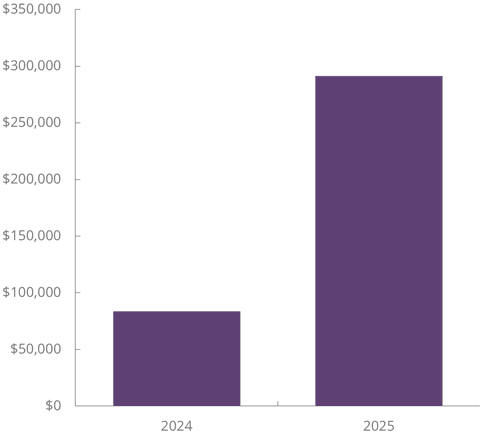
Ultimately, the interaction between smart grids and cities will represent a significant proportion of energy cost savings that utilities and consumers will reap; resulting in $291.4 billion saved in 2029, increasing 249% from $83.5 billion in 2024.
Total Smart Grid Energy & Emissions Cost Savings ($m), 2024 vs. 2025
Source: Juniper Research
As a Research Analyst, Matthew provides invaluable analysis, competitive benchmarking, and forecasting on sustainability markets including Smart Grid and Mobility-as-a-Service. His research has been covered by leading media outlets such as Bloomberg, Fortune, and Forbes.
Related Research
-
 ReportSeptember 2025Emerging Technology
 Adam WearsSmart Grid Market, 2025-2030
Our cutting-edge Smart Grid research suite provides a comprehensive view of a market at the forefront of the global energy transition. It examines the major disruptions transforming the sector, from the integration of distributed energy resources and the rise of virtual power plants to the growing role of AI-driven intelligence and the mounting need for robust cyber security and compliance.
VIEW
Latest research, whitepapers & press releases
-
 ReportOctober 2026Fintech & Payments
 Michael GreenwoodAccounts Payable Automation Market: 2026-2031
Our Accounts Payable (AP) Automation research suite provides an insightful analysis of this rapidly growing market; enabling stakeholders to understand future growth, key trends and the competitive environment.
VIEW -
 ReportOctober 2026Fintech & Payments
 Jawad JahanCrypto-gaming Market: 2026-2035
Our Crypto-gaming Market research suite provides an insightful analysis of this rapidly growing market; enabling stakeholders - from crypto-gaming and sportsbooks operators, prediction market platforms, business-to-business (B2B) gambling platforms and software providers, to crypto payment processors and regulators - to understand future growth, key trends, and the competitive environment.
VIEW -
 ReportOctober 2026Telecoms & Connectivity
 Alex WebbRetail Roaming Market: 2026-2031
Our Retail Roaming research suite for mobile network operators (MNOs) and mobile virtual network operators (MVNOs) provides detailed analysis and strategic recommendations for the next era of retail roaming.
VIEW -
 ReportSeptember 2026Fintech & Payments
 Dr Manju ChhillarEmbedded Finance Market: 2026-2031
Embedded finance is one of the fastest-growing markets in financial services, and is about to accelerate even further. Our Embedded Finance Market research provides detailed analysis of the key drivers behind this growth, and what these mean for stakeholders in this market.
VIEW -
 ReportSeptember 2026Identity & Security
 Thomas WilsonApplication Security Market: 2026-2031
Our Application Security research suite provides detailed analysis of this emerging market; allowing application security providers to gain an understanding of key security trends and challenges, potential growth opportunities, and the competitive environment.
VIEW -
 ReportSeptember 2026Fintech & Payments
 Shane O'SullivanBanking Fraud Prevention Market: 2026-2031
Our Banking Fraud Prevention research suite provides a comprehensive and in-depth analysis of the types of fraud currently impacting the banking sector, and the evolving methods that can be used to overcome them.
VIEW


-
 WhitepaperOctober 2026Fintech & Payments
Michael Greenwood
WhitepaperOctober 2026Fintech & Payments
Michael GreenwoodAccounts Payable Automation ~ How Businesses Are Reducing Operational Costs
Our complimentary whitepaper, Accounts Payable Automation ~ How Businesses Are Reducing Operational Costs, analyses how AP automation is combatting costs by decreasing the need for manual processes, and provides strategic insight into a number of key trends in the AP automation space.
VIEW -
 WhitepaperOctober 2026Fintech & Payments
Jawad Jahan
WhitepaperOctober 2026Fintech & Payments
Jawad JahanCompliance or Anonymity - The Crypto-gaming Operator’s Dilemma
Our complimentary whitepaper, Compliance or Anonymity - The Crypto-gaming Operator’s Dilemma, analyses the current regulatory landscape of the crypto-gaming market.
VIEW -
 WhitepaperOctober 2026Telecoms & Connectivity
Alex Webb
WhitepaperOctober 2026Telecoms & Connectivity
Alex WebbReimagining the Future of Retail Roaming – How Mobile Network Operators Must Adapt
Our complimentary whitepaper, Reimagining the Future of Retail Roaming – How Mobile Network Operators Must Adapt, explores the emerging opportunities for MNOs within retail roaming.
VIEW -
 WhitepaperSeptember 2026Fintech & Payments
Dr Manju Chhillar
WhitepaperSeptember 2026Fintech & Payments
Dr Manju ChhillarEmerging Markets: The Next Opportunity for Embedded Finance
This free whitepaper examines how a combination of multiple factors is driving North America towards saturation for embedded finance.
VIEW -
 WhitepaperSeptember 2026Emerging Technology
Thomas Wilson
WhitepaperSeptember 2026Emerging Technology
Thomas WilsonVibe Coding: The Fastest-growing Threat to Application Security Today
Our complimentary whitepaper, Vibe Coding: The Fastest-growing Threat to Application Security Today, examines the state of the application security market; considering its impact on different verticals, and how it is being employed in these verticals to best combat malicious attackers and keep sensitive data safe.
VIEW -
 WhitepaperSeptember 2026Fintech & Payments
Shane O'Sullivan
WhitepaperSeptember 2026Fintech & Payments
Shane O'SullivanThe Fraud Frontier: Securing Banking in an AI-driven Era
Our complimentary whitepaper, The Fraud Frontier: Securing Banking in an AI-driven Era, examines the rapidly evolving state of the banking fraud prevention market.
VIEW


-
Fintech & Payments
Accounts Payable Automation to Save Global Businesses 6.2 Billion Hours by 2031, Accelerated by Business System Integration
October 2026 -
Fintech & Payments
The 25th NextGen Payments & RegTech Forum Arrives in Athens, Greece
October 2026 -
Fintech & Payments
Crypto Gaming: Wagers to Reach $1.3 Trillion by 2035, as Crypto Rails Widen Global Access Despite Regulatory Challenges
October 2026 -
Fintech & Payments
Juniper Research Unveils Identity & Security Award Winners for 2026
October 2026 -
Retail Roaming Revenue to Fall $4 Billion By 2031, as Regulatory Restrictions and Competition Bite
October 2026 -
Fintech & Payments
Soft POS to Surpass 100 Million Installations in 2030
September 2026